
In the evolving world of residential and commercial construction, builders and homeowners are constantly seeking methods that offer durability, energy efficiency, and speed.
One technology that checks all these boxes is ICF in Construction, or Insulated Concrete Forms.
While it has been used in Europe since the 1940s and in North America for several decades, ICF construction has seen a significant surge in popularity as building codes become stricter and demand for resilient housing grows .
What is ICF?
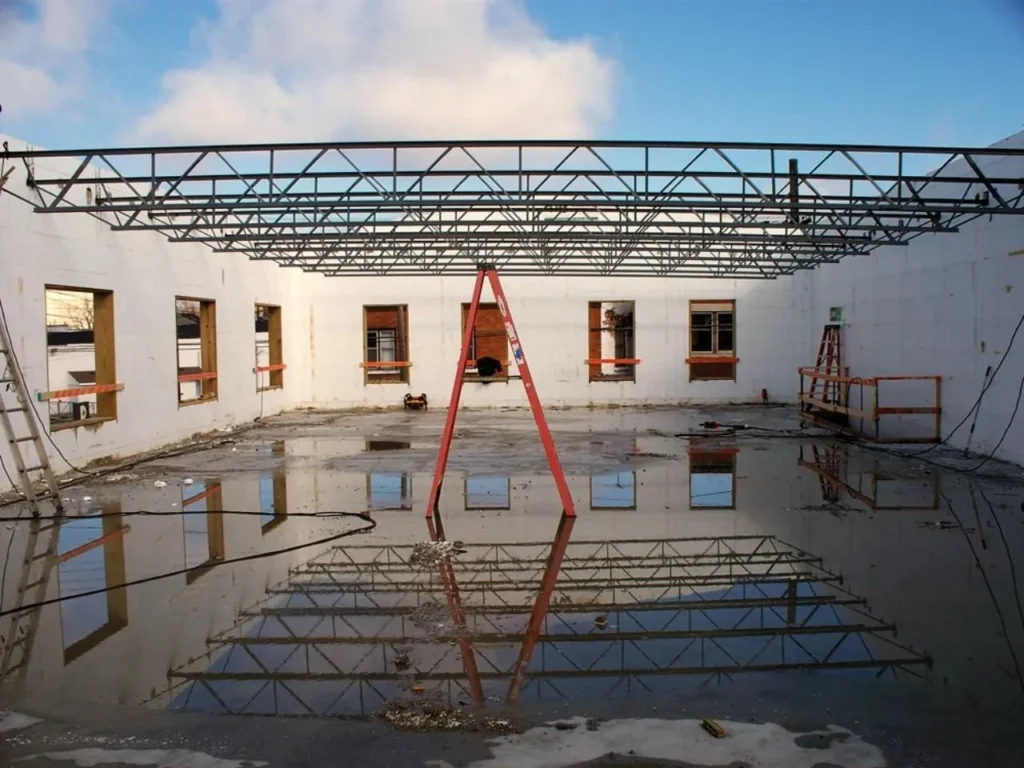
ICF stands for Insulated Concrete Forms.
It is a construction system used for building walls. Essentially, it involves stacking hollow blocks or panels made of rigid foam insulation (like Styrofoam) to create the shape of a building.
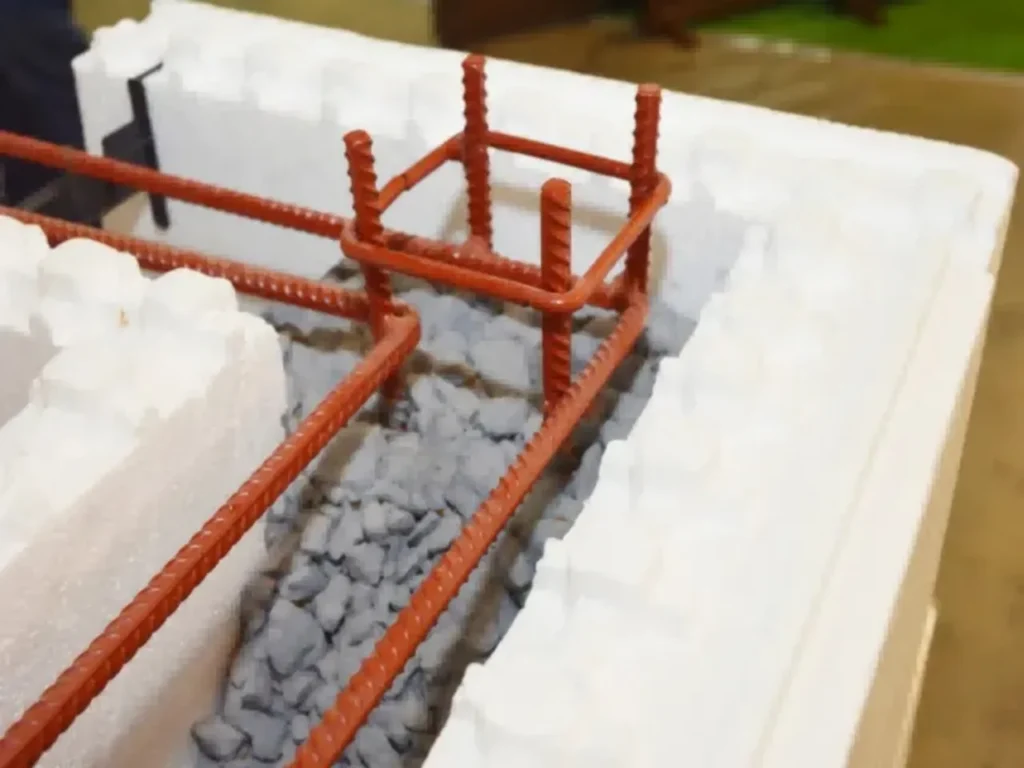
These forms are then filled with reinforced steel rebar and poured concrete.
The key distinction is that the foam forms are not removed after the concrete hardens. They stay in place permanently, serving as the insulation for both the interior and exterior of the building.
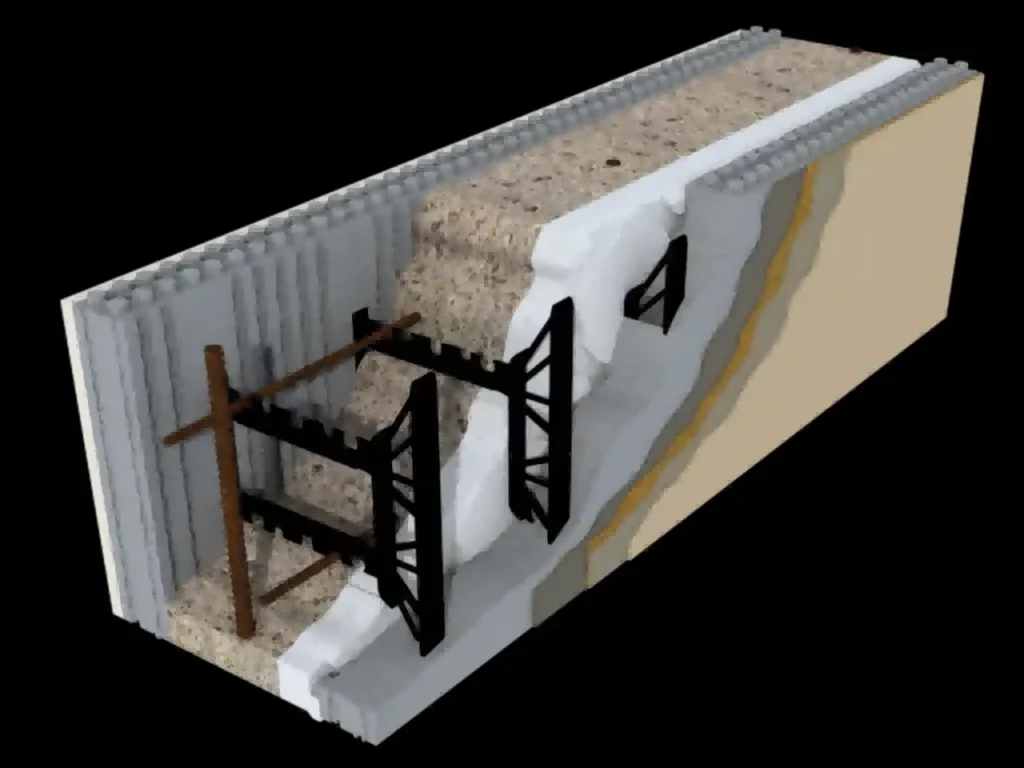
This creates a finished wall with three layers:
- Interior Foam: Provides insulation and a surface for drywall.
- Concrete Core: Provides extreme structural strength.
- Exterior Foam: Provides insulation and a surface for siding or brick.
In short, it is a method to build concrete walls that are already insulated, energy-efficient, and incredibly durable.
The Components and Types of ICF in Construction
The Core Components of an ICF in Construction
Every ICF system is built around three main physical components that work together to create the final wall assembly.
- The Insulating Foam (The Forms):
- Material: The vast majority of ICF blocks are made from Expanded Polystyrene (EPS) . This is a rigid, lightweight foam plastic. Its closed-cell structure makes it highly resistant to moisture absorption and provides excellent thermal insulation.
- Function: The foam acts as the “mold” or formwork for the concrete pour. Because it stays in place permanently, it also serves as the interior and exterior insulation for the lifetime of the building.
- The Connectors (The Webs):
- Material: These are typically made of high-strength plastic or sometimes galvanized steel.
- Function: The plastic or metal “webs” serve two critical purposes:
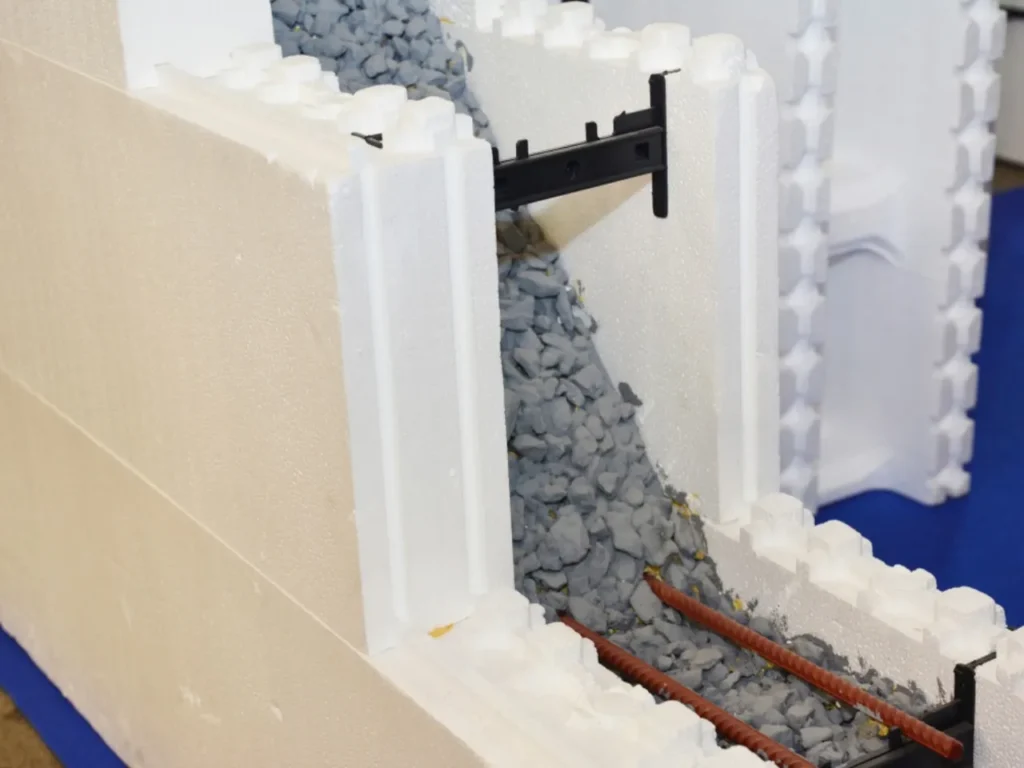
- Spacing: They hold the two panels of foam a precise distance apart (usually 4 to 12 inches), creating the hollow cavity that will be filled with concrete.
- Attachment: They provide a solid surface (nailable strips) for attaching interior finishes like drywall and exterior claddings like siding, without needing to penetrate the concrete core.
- The Reinforcement and Structure:
- Material: Steel reinforcing bars (rebar) and ready-mix concrete.
- Function: Before the concrete is poured, horizontal and vertical rebar is placed inside the hollow foam cavity, as specified by engineering plans. Once the concrete is pumped in, it encases the rebar, creating a steel-reinforced concrete wall that provides the building’s structural integrity.
The Three Main Types of ICF in Construction
While all ICF systems use the components above, they differ in the final shape of the concrete inside the wall. There are three primary configurations, each offering different structural and thermal characteristics:
1. Flat Wall Systems
- Description: This is the most common and widely used type of ICF. The plastic webs hold the foam panels parallel to each other, creating a continuous, uniform void.
- Result: When filled, the concrete forms a solid wall of consistent thickness (e.g., 4, 6, or 8 inches thick).
- Best For: This system offers the highest structural strength and the greatest design flexibility for openings. It is the preferred choice for load-bearing walls, basements, safe rooms, and areas prone to severe weather (hurricanes/tornadoes).
2. Grid (or Waffle) Systems
- Description: In this design, the foam forms create a series of interconnected horizontal and vertical voids. The foam takes up more space within the wall assembly.
- Result: When concrete is poured, it forms a grid-like concrete structure. The concrete is thicker at the intersections of the grid (creating a “waffle” pattern), while the areas in between are just foam.
- Best For: This system uses less concrete than a flat wall, which can reduce material costs and the overall weight of the structure. It is suitable for applications where the extreme strength of a full concrete wall is not required.
3. Post and Beam (or Screen Grid) Systems
- Description: This system creates larger, more widely spaced voids within the foam forms.
- Result: The concrete forms discrete vertical columns (posts) and horizontal beams, rather than a continuous wall. The structural loads are carried entirely by these concrete posts, while the foam panels in between serve only as insulation.
- Best For: This system uses the least amount of concrete. It is less common in residential construction today but can be used for specific aesthetic or structural engineering requirements where isolated structural supports are desired.
In summary, while the materials (foam, webs, rebar, concrete) remain constant, choosing between a Flat, Grid, or Post and Beam system depends on the structural requirements of the project and the desired balance between concrete usage and insulation value.
ICF in Construction Process
Step 1: Foundation Preparation
The process begins with a traditional concrete footing, just like in standard construction.
- The Setup: A standard concrete footing is poured at the base of the building.
- The Connection: Steel rebar dowels are left protruding vertically out of the footing. These dowels are crucial because they will later be tied into the ICF wall, locking the new walls firmly to the foundation.
Step 2: Stacking the Forms
Once the footing is cured, the actual ICF construction begins.
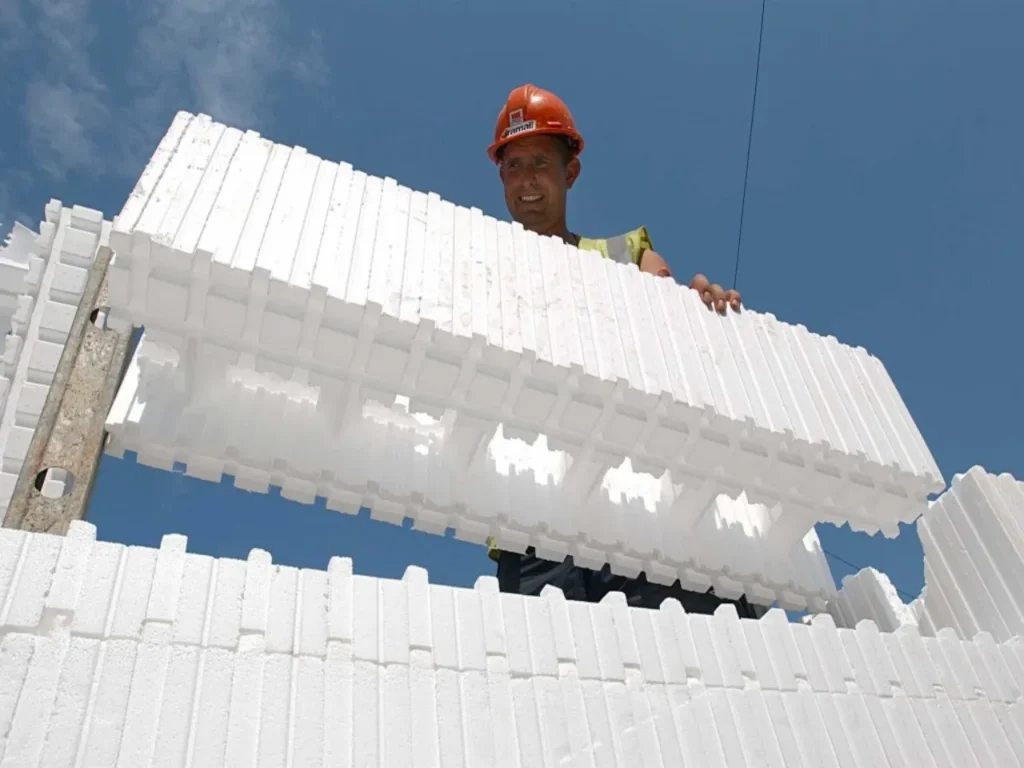
- The Material: The lightweight EPS (Expanded Polystyrene) blocks are delivered to the site. They are designed to be light enough for a single worker to carry.
- Stacking: Workers begin stacking the hollow blocks on the foundation, fitting them together using interlocking edges (similar to Lego). The blocks are easily cut on-site with a hand saw or a hot knife to fit around corners, window openings, and door frames.
Step 3: Installing Reinforcement
Before any concrete is poured, the wall must be strengthened internally.
- Rebar Placement: Horizontal and vertical steel rebar is placed inside the hollow core of the blocks. The rebar is tied to the dowels coming from the foundation and secured to the plastic webs inside the ICF blocks.
- Engineering: The spacing and thickness of the rebar are determined by structural engineers based on the building’s height and local wind/seismic loads. This step is what gives the finished wall its incredible tensile strength.
Step 4: Bracing the Walls
This is one of the most critical safety steps in the process.
- Purpose: Before concrete arrives, the entire wall system must be braced. Liquid concrete is extremely heavy (approx. 150 lbs per cubic foot) and exerts immense pressure on the forms.
- Method: Temporary aluminum or wood braces are installed on the outside of the forms. They are anchored to the ground or the foundation and adjusted to ensure the walls are perfectly plumb (vertical), level, and straight. If this step is skipped or done poorly, the walls could bulge or collapse during the pour (a “blowout”).
Step 5: Pouring the Concrete
This is the fastest part of the process, usually taking only a few hours for a typical home.
- The Mix: Concrete is pumped into the forms. It requires a specific mix design with a higher “slump” (wetness) and smaller aggregate than standard foundation concrete to ensure it flows completely throughout the forms and around the rebar.
- The Process: The concrete is pumped from the bottom up in layers (called “lifts”) to ensure even distribution and to prevent voids or air pockets.
- Monitoring: Workers constantly monitor the pour from the ground, watching for any signs of pressure that could cause a “blowout” (where a block fails).
Step 6: Curing and Finishing
- Curing: Once the concrete is poured, it needs time to cure (harden). The foam insulation actually helps with this process by protecting the concrete from extreme temperatures and allowing it to cure at a consistent rate.
- Finishing: After the concrete is hard and the temporary braces are removed, the construction moves to the finishing trades:
- Interior: Drywall can be screwed directly into the plastic webs (ties) that are embedded in the foam.
- Exterior: The foam provides a perfect substrate for attaching exterior cladding like brick, stone, stucco, or siding using specialized longer fasteners that anchor into the concrete core.
Summary of the Workflow
To visualize it simply:
- Prep: Pour footing with rebar sticking up.
- Stack: Place foam blocks like bricks.
- Reinforce: Add steel rebar inside the foam.
- Brace: Install supports to hold the walls straight.
- Pour: Fill with concrete.
- Finish: Remove braces and attach drywall/siding.
The Key Benefits of ICF in Construction
1. Unmatched Energy Efficiency
This is often the primary reason homeowners and builders choose ICF. The energy savings come from two physical properties of the wall assembly: continuous insulation and thermal mass.
- Elimination of Thermal Bridging: In a standard wood-frame wall, the studs are conductive. Heat escapes through the wood, bypassing the insulation (this is called thermal bridging). ICF walls have a continuous layer of foam on both the interior and exterior, meaning there are no gaps in the insulation. This results in whole-wall R-values that are significantly higher than stick framing.
- Theral Mass (Thermal Lag): The massive concrete core acts as a thermal battery. It slowly absorbs heat during the day and releases it at night (and vice versa in summer). This “thermal lag” dampens temperature swings, keeping the home cooler in the afternoon and warmer at night.
- Result: These factors combine to reduce heating and cooling costs by 20% to 50% compared to traditionally framed homes.
2. Exceptional Strength and Durability
The steel-reinforced concrete core makes ICF walls incredibly resilient against both natural disasters and time.
- Disaster Resistance: ICF walls are designed to withstand extreme forces. They have been tested to survive EF-4 and EF-5 tornado winds (over 250 mph) and hurricane storm surge. The concrete is non-combustible, providing a fire resistance rating of up to 4 hours—far exceeding wood framing.
- Longevity: Because the materials are inorganic (concrete, steel, and foam), they do not rot, rust, or warp. They are also impervious to termites and other pests. This means an ICF home can last significantly longer with less structural maintenance than a wood home.
3. Health, Safety, and Comfort
Beyond energy and structure, ICF provides a superior indoor environment.
- Acoustic Control (Quieter Homes): The mass of the concrete and the closed-cell foam create an exceptional sound barrier. ICF walls can reduce outside noise transmission by up to two-thirds (approximately 60-70%) compared to wood framing.
- Improved Indoor Air Quality: The poured concrete creates a monolithic structure that is virtually airtight. This prevents outdoor pollutants, pollen, dust, and pests from infiltrating the living space through the walls.
- Note: Because these homes are so airtight, they require a mechanical ventilation system (like an HRV or ERV) to ensure a constant supply of fresh air and manage humidity, which further improves air quality.
- Consistent Temperatures (No Drafts): The airtightness also eliminates the drafts associated with leaks in wood-frame construction, leading to a more comfortable living environment without “cold spots.”
4. Speed of Construction
While it seems like a heavy material, ICF construction can actually be faster than traditional methods.
- Combined Steps: The structure, insulation, and air barrier are all installed in one single step. In wood framing, these are three separate processes that require different trades and materials.
- Weather Independence: Because the foam blocks are not damaged by rain, construction can continue in wet weather without delaying the schedule.
- Labor Efficiency: A small crew of 3-4 people can erect the walls for an entire house in just a few days, reducing on-site labor time.
Disadvantages and Considerations of ICF in Construction
Higher Upfront Costs
This is the most common barrier to entry for ICF construction. While it saves money over the long term through energy efficiency, the initial investment is higher.
- Material Premium: The cost of the ICF blocks themselves, the specialized plastic webs, and the required rebar is generally higher than dimensional lumber for stick framing.
- Concrete Volume: You are paying for a significant volume of ready-mix concrete, which is more expensive than empty wall cavities.
- The Numbers: Industry data suggests that ICF construction can add approximately $3 to $5 per square foot to the cost of a home compared to standard wood framing. This can translate to a 1% to 5% increase in the overall sales price of the building.
- Consideration: Proponents argue that this premium is often mitigated by lower insurance premiums (due to disaster resistance) and significantly reduced energy bills, allowing the upfront cost to be recouped over time.
Specialized Labor and Learning Curve
While stacking the blocks is simple, ensuring the structure is safe requires experienced oversight.
- Availability: In many regions, finding subcontractors who are experienced with ICF can be difficult. Builders who have only ever worked with wood may be hesitant to take on an ICF project.
- The Pour is Critical: The concrete pour is the most dangerous moment. If the crew does not understand how to manage the pressure of the wet concrete (pouring too fast, using the wrong slump), the walls can rupture, causing a catastrophic “blowout.”
- Supervision: While unskilled labor can stack blocks, the project hinges on experienced supervision to ensure bracing is secure and rebar is placed correctly.
Design and Renovation Limitations
Concrete is permanent. This makes last-minute changes or future renovations much more difficult than with wood.
- Lack of Flexibility: In wood framing, moving a door or window after the frame is up is relatively easy. With ICF, once the concrete is poured, the opening locations are locked in permanently. Cutting a new window into an ICF wall requires diamond-bladed saws and significant labor.
- Chasing Utilities: Running electrical wiring and plumbing requires “chasing” (cutting grooves) into the foam. This must be done carefully to avoid breaching the interior foam surface or damaging the concrete core. It takes more planning than simply drilling through wood studs.
- Future Additions: Adding an extension to an ICF home years later can be complex, as you must figure out how to tie new concrete walls into the old ones or transition between concrete and wood framing.
Environmental Concerns (Embodied Carbon)
While ICF homes are “green” to operate, their construction has a significant environmental footprint.
- Concrete Production: Cement, the key ingredient in concrete, is responsible for a significant percentage of global CO2 emissions.
- Foam Production: EPS foam is a petroleum-based product. While it is highly durable and does not degrade, its manufacturing process is energy-intensive and relies on fossil fuels.
- The Trade-Off: This is a “pay now or pay later” scenario. The embodied carbon (the CO2 emitted to make the materials) is high upfront. However, the operational carbon (the CO2 emitted by heating/cooling the home over 50 years) is very low. Studies generally show that ICF homes can offset their carbon debt within a few years through energy savings.
- Note: The industry is actively mitigating this by introducing low-carbon concrete mixes (using GGBS or fly ash) and recycled content in the plastic webs.
Interior Moisture and Ventilation Requirements
Because ICF homes are so airtight, they require mechanical intervention to stay healthy.
- The Airtight Paradox: The monolithic concrete core stops air leakage almost completely. While this stops drafts, it also traps moisture (from cooking, breathing, showers) inside the house.
- Required Ventilation: Unlike a leaky wood-frame home that naturally exchanges air, an ICF home must have a mechanical ventilation system, such as an HRV (Heat Recovery Ventilator) or ERV (Energy Recovery Ventilator) . This adds to the initial mechanical system cost.
- Condensation Risk: If the interior humidity is not managed properly during construction (while concrete is curing) or during occupancy, there is a potential risk of condensation on the interior surfaces if the HVAC system is not correctly balanced.
ICF vs. Traditional Construction
| Feature | ICF Construction | Wood-Frame Construction |
|---|---|---|
| Structure | Steel-reinforced concrete | Wood studs |
| Insulation | Continuous (no thermal bridging) | Interrupted by studs (thermal bridging) |
| Airtightness | Excellent (monolithic concrete) | Requires careful sealing and taping |
| Durability | Resists rot, pests, fire, high winds | Vulnerable to termites, rot, and fire |
| Cost | Higher initial material cost | Lower initial cost |
| Build Speed | Fast erection, less weather dependent | Slower, weather dependent |
| Design Flexibility | Must be planned in advance; hard to modify | Easier to modify during/after construction |
Conclusion
Insulated Concrete Form construction represents a significant shift toward high-performance, resilient building.
It offers a compelling package of energy efficiency, structural strength, and occupant comfort that traditional methods struggle to match.
ICF is an outstanding choice for homeowners in regions prone to extreme weather, those seeking to build a net-zero energy home, or anyone willing to invest a little more upfront for long-term durability and lower operating costs .
For basements, it is often considered the best available method, frequently costing the same or less than a traditionally finished basement while providing a warmer, drier space .
As the construction industry faces labor shortages and stricter energy codes, the efficiency and performance of ICF make it a technology whose time has truly arrived .