
Expanded Polypropylene (EPP) insulation boxes have revolutionized the cold chain logistics industry, offering superior thermal protection, exceptional durability, and complete recyclability.
These lightweight yet robust containers are essential for transporting temperature-sensitive goods—from pharmaceuticals and vaccines to fresh food and seafood.
Understanding the production process of EPP insulation boxes is crucial for manufacturers, quality control professionals, and procurement specialists seeking to ensure product excellence.
Understanding EPP Material and Its Properties
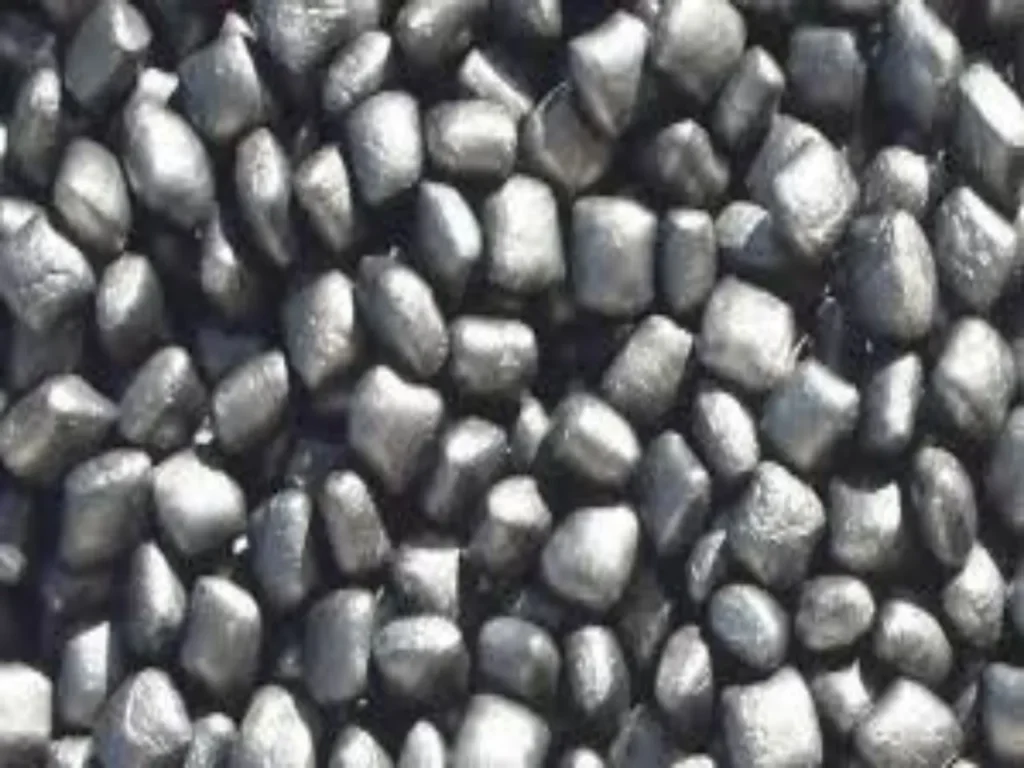
Before diving into the production process, it’s essential to understand what makes EPP the material of choice for insulation boxes.
What Is EPP?
Expanded Polypropylene (EPP) is a highly versatile closed-cell bead foam made from polypropylene resin.
Developed in the early 1980s in Japan, EPP has become a mainstay in industries requiring outstanding impact resistance and energy absorption while maintaining lightweight characteristics .
Key Properties for Insulation Applications
EPP insulation boxes leverage several inherent material advantages:
- Exceptional Thermal Insulation: The closed-cell structure traps air, providing excellent temperature retention for cold chain applications
- Superior Impact Resistance: EPP absorbs energy through cell deformation, protecting contents from physical damage
- Lightweight: Typically 95-98% air by volume, reducing shipping costs
- Complete Recyclability: 100% recyclable and environmentally friendly
- Chemical Resistance: Resistant to oils, greases, and many chemicals
- Temperature Stability: Maintains properties from -40°C to +130°C
- Water Resistance: Closed-cell structure prevents moisture absorption
- Multiple-Impact Protection: Unlike EPS, EPP recovers after compression, offering repeated impact protection
EPP vs. EPS for Insulation Boxes
While both materials serve insulation applications, EPP offers distinct advantages:
| Property | EPP Insulation Box | EPS Insulation Box |
|---|---|---|
| Impact Resistance | Excellent (flexible, recovers) | Brittle (cracks, permanent damage) |
| Durability | Multiple-use capable | Typically single-use |
| Recyclability | 100% recyclable (Type 5) | Recyclable but less common |
| Temperature Range | -40°C to +130°C | -40°C to +75°C |
| Surface Texture | Smooth, flexible | Rigid, friable surface |
| Cost | Higher initial investment | Lower initial cost |
Key Insight: EPP insulation boxes command a higher upfront cost but deliver lower total cost of ownership through reusability, superior protection, and reduced product loss in cold chain applications.
Overview of the EPP Insulation Box Production Process
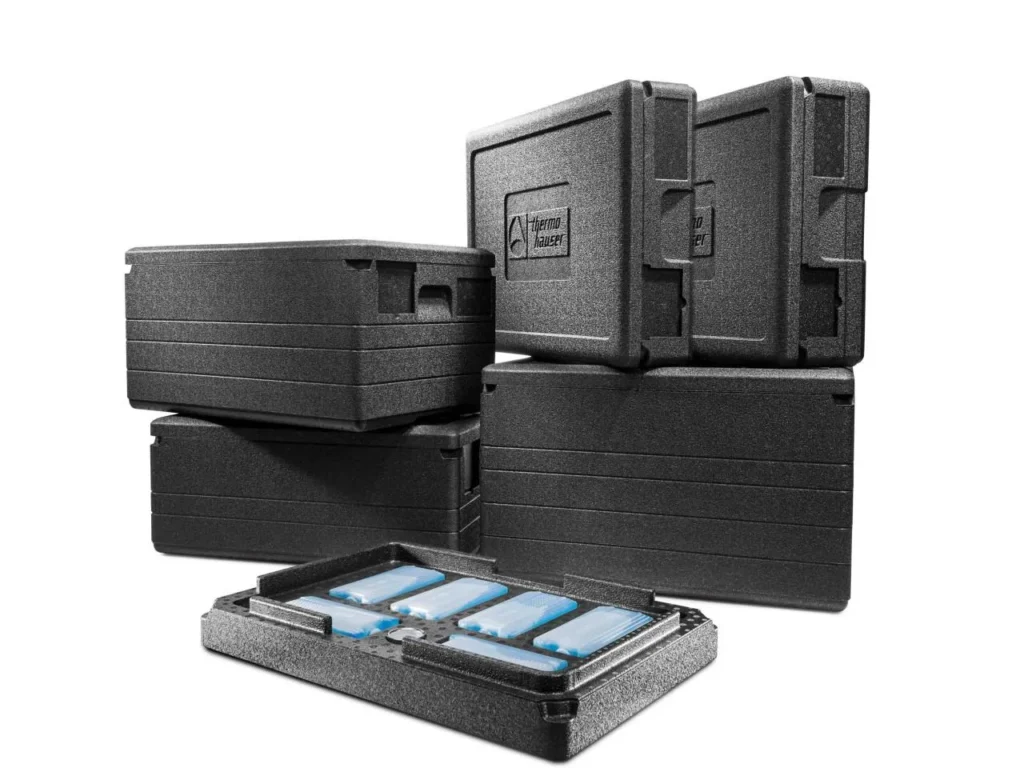
The manufacturing of EPP insulation boxes follows a systematic multi-stage process, primarily utilizing steam-chest molding technology .
Steam-chest molding is an integral process for EPP technology, where steam both expands the beads and fuses them together within a closed mold .
The complete production cycle encompasses:
- Raw Material Preparation – Selection and conditioning of EPP beads
- Pre-Expansion – Initial bead expansion to target density
- Intermediate Aging/Stabilization – Pressure stabilization period
- Steam-Chest Molding – The core shaping and fusion process
- Cooling and Demolding – Solidification and part removal
- Post-Processing – Annealing, finishing, and customization
- Quality Control – Comprehensive testing and inspection
Let’s examine each stage in meticulous detail.
Stage 1: Raw Material Preparation
Material Selection
The foundation of a quality EPP insulation box begins with 100% virgin polypropylene (PP) resin. Reputable manufacturers strictly avoid recycled or contaminated materials that could compromise:
- Structural integrity and durability
- Food contact safety (for food-grade applications)
- Consistency in expansion behavior
- Surface finish quality
Raw Material Form
EPP arrives at manufacturing facilities in the form of small beads (typically 1-4 mm diameter) containing a blowing agent within the polymer matrix.
These beads have been pre-impregnated with gas during the manufacturer’s production process.
Material Screening
Before processing, beads undergo screening to:
- Remove undersized or oversized particles
- Eliminate any clumped or damaged material
- Ensure uniform size distribution for consistent expansion
Drying
Raw PP beads contain residual moisture that can interfere with expansion. Beads are dried in controlled environments at 50-60°C for 2-4 hours to achieve optimal moisture content .
Stage 2: Pre-Expansion
Pre-expansion is the critical first step that determines the final density and cell structure of the EPP insulation box.
Purpose of Pre-Expansion
The as-received EPP beads are dense and must be expanded to achieve the lightweight foam structure. Pre-expansion accomplishes:
- Initial bead volume increase (typically 10-40 times)
- Formation of the closed-cell structure
- Creation of the characteristic foam properties
The Pre-Expansion Process
Pre-expanded beads are created by:
- Loading: Raw beads are fed into a pre-expansion vessel
- Steam Introduction: High-temperature steam (typically 100-150°C) is introduced
- Expansion: The heat softens the polymer, allowing the internal blowing agent to expand, creating the cellular structure
- Density Control: Expansion time and steam pressure are precisely controlled to achieve target density (typically 15-60 g/L for insulation boxes)
- Discharge: Expanded beads are pneumatically conveyed to storage silos
Expansion Ratio Control
The expansion ratio directly affects final box properties:
| Density (g/L) | Expansion Ratio | Insulation Performance | Structural Strength | Typical Application |
|---|---|---|---|---|
| 20-30 | 35-40x | Maximum | Lower | Light-duty insulation |
| 30-45 | 25-35x | Excellent | Good | Standard insulation boxes |
| 45-60 | 15-25x | Good | Excellent | Heavy-duty reusable boxes |
| 60-90 | 10-15x | Moderate | Maximum | Structural components |
Critical Note: Pre-expansion parameters must be tightly controlled (±2% density variation) to ensure consistent final product quality .
Stage 3: Intermediate Aging
After pre-expansion, beads cannot be immediately molded. They require a stabilization period of 12 to 48 hours , sometimes extending to 24-72 hours .
Purpose of Aging
The aging process serves several vital functions:
- Pressure Equalization: Freshly expanded beads contain internal pressure from residual blowing agent and hot air. Aging allows this pressure to equilibrate with atmosphere.
- Air Infusion: As beads cool, they create a slight vacuum that draws air into the cells, replacing some of the original blowing agent.
- Dimensional Stabilization: Prevents post-molding shrinkage by stabilizing the bead structure .
- Optimized Molding Behavior: Properly aged beads expand more uniformly during final molding.
Aging Conditions
- Storage: Well-ventilated silos or containers
- Temperature: Ambient (20-25°C)
- Humidity: Controlled, dry environment
- Duration: Optimized based on bead density and ambient conditions
Why This Matters: Insufficient aging leads to post-molding shrinkage and dimensional instability. Excessive aging can reduce expansion capability during molding .
Stage 4: Steam-Chest Molding – The Core Process
Steam-chest molding is the heart of EPP insulation box production, where aged beads are transformed into finished products through precise application of heat and pressure .
Mold Preparation
Before machine production begins:
- Mold Selection: Custom-designed aluminum or steel molds matching the exact box geometry are installed in the molding press
- Mold Preheating: The mold is heated to near the melting point of polypropylene (approximately 140-160°C) to ensure proper bead fusion
- Surface Treatment: Mold surfaces may be treated or coated to achieve desired surface texture
Mold Filling
The molding cycle begins:
- The mold closes with precise alignment of male and female halves
- Aged EPP beads are pneumatically conveyed into the mold cavity through fill nozzles
- Quantitative filling ensures each cavity receives exactly the same volume of beads (±2% tolerance)
- Fill density is calculated to achieve final part density after expansion
Steam Injection – The Three-Phase Process
Once filled, the mold undergoes a carefully sequenced steam injection process :
Phase A: Steam Flush
- Action: Steam enters from the top of the mold while bottom valves remain open
- Purpose: Forces air out of the mold and bead interstitial spaces
- Result: Creates a steam-rich environment throughout the mold
- Valve Configuration: Upper steam valve open, lower condensate valve open
Phase B: Cross-Steam
- Action: Steam sweeps horizontally through the bead mass
- Direction: Alternates between left-to-right and right-to-left
- Purpose: Ensures uniform heating of all beads, especially in complex geometries with thin sections (flanges, ribs)
- Critical for Complex Shapes: Steam must penetrate thin sections to fuse beads in confined areas
- Valve Configuration: One side steam valve open, opposite side condensate valve open; then reverses
Phase C: Pressure Hold
- Action: All vents close, allowing pressure to build to peak
- Temperature: Reaches approximately 140°C
- Purpose: Bead surfaces become soft and fuse together, creating a monolithic foam structure while maintaining the closed-cell integrity
- Duration: Maintained until complete inter-bead fusion achieved
Steam Pressure Optimization
Research demonstrates that steam pressure significantly affects final product properties.
Studies on steam-chest molding have varied steam pressure to determine optimum conditions for EPP foam manufacturing . Higher steam pressures generally improve fusion but risk cell collapse if excessive.
The Fusion Mechanism
During steam exposure :
- Surface Softening: Steam heat softens the outer surface of each bead
- Inter-Bead Bonding: Softened surfaces contact adjacent beads
- Molecular Diffusion: Polymer chains entangle across bead boundaries
- Monolithic Structure: Upon cooling, beads form a continuous foam matrix
The result is a continuous, monolithic foam structure that maintains the characteristic cell structure and properties of EPP while achieving the desired shape .
Stage 5: Cooling and Demolding
After steam fusion, the molded box must be stabilized before removal.
Cooling Process
Cooling is critical for dimensional stability and preventing post-ejection deformation:
- Cooling Initiation: Steam valves close, cooling begins
- Cooling Methods: Typically spray cooling (water mist) combined with vacuum assistance
- Target Temperature: Mold must cool to approximately 70°C before demolding
- Cooling Duration: Ranges from 30 minutes to 2+ hours depending on box wall thickness
Demolding
Once adequately cooled:
- Pressure Release: Internal mold pressure is carefully vented
- Ejection: Ejector pins or plates push the finished box from the mold
- Inspection: Visual check for obvious defects
- Transfer: Parts move to post-processing area
Critical Consideration: Premature demolding causes warpage, dimensional changes, and internal stresses that compromise box performance.
Stage 6: Post-Processing Operations
After demolding, EPP insulation boxes may undergo several finishing operations.
Annealing
Annealing is a crucial post-molding treatment to prevent shrinkage of the steam-molded product .
- Process: Molded boxes are placed in controlled-temperature environments
- Temperature: Typically 60-80°C
- Duration: Varies based on part thickness (typically 2-24 hours)
- Purpose:
- Stabilize dimensions
- Relieve internal stresses
- Complete any residual expansion
- Ensure long-term dimensional stability
Research confirms that annealing after EPP foam molding prevents shrinkage by allowing controlled relaxation of internal stresses .
Trimming and Deflashing
- Removal of minor flash (thin excess material at parting lines)
- Trimming of fill nozzle remnants
- Edge smoothing for safety and aesthetics
Surface Finishing
Depending on application requirements:
- As-molded surface (standard)
- Heat-treated surface for enhanced appearance
- Laminated surfaces (fabric, film, or foil) for enhanced insulation or branding
- Printed graphics (logos, handling instructions, temperature indicators)
Secondary Assembly
Some boxes undergo additional assembly:
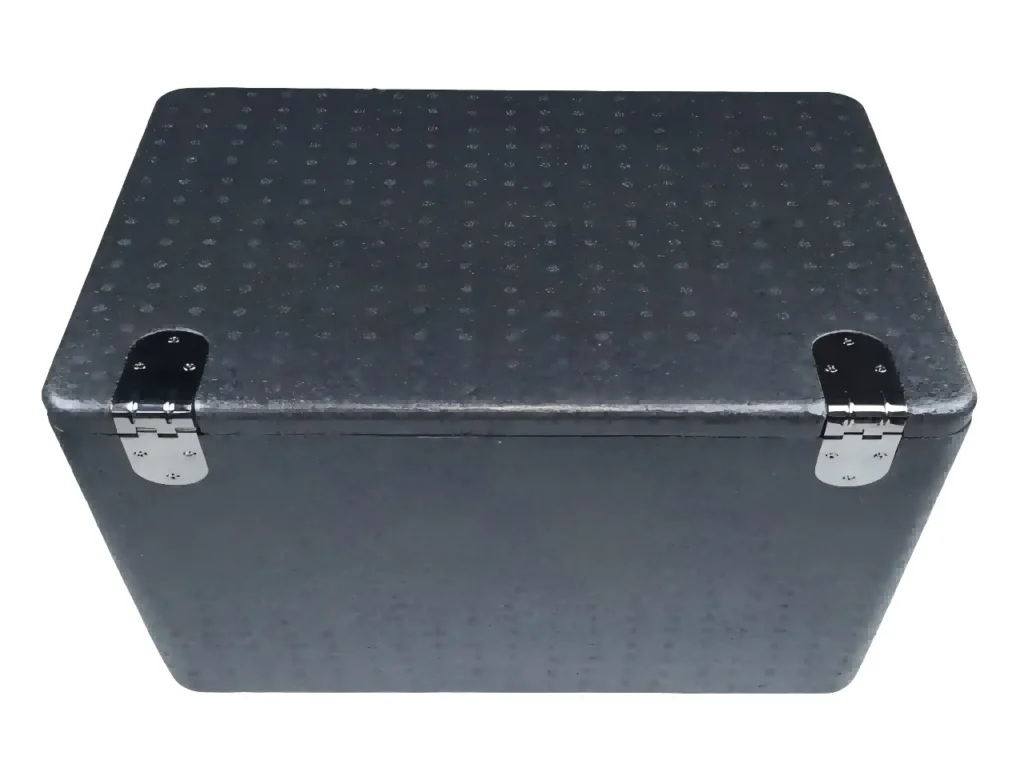
- Hinge installation (for hinged-lid boxes)
- Latch or closure attachment
- Gasket installation (for enhanced sealing)
- RFID tag integration (for tracking)
- Phase change material (PCM) integration (for advanced thermal management)
Stage 7: Quality Control and Testing
Comprehensive quality assurance ensures every EPP insulation box meets performance specifications .
Dimensional Inspection
- Critical Dimensions: Verify against CAD specifications
- Wall Thickness: Ensure uniform distribution
- Flatness: Check lid and base sealing surfaces
- Squareness: Verify box geometry
Physical Property Testing
Density Verification:
- Measure weight and volume
- Calculate actual density vs. specification
- Ensure consistency across production batches
Mechanical Testing:
- Compression strength (stacking capability)
- Impact resistance (drop testing)
- Flexural properties (handling durability)
Thermal Performance Testing:
- Thermal conductivity measurement (k-factor)
- Temperature retention testing (real-world cold chain simulation)
- Thermal cycling (repeated temperature changes)
Environmental Testing
- Temperature resistance: -40°C to +130°C exposure
- Humidity resistance: High-humidity storage
- UV exposure (if applicable for outdoor use)
Durability Testing
- Repeated drop testing: 1.5m drops, multiple impacts
- Cycle testing: Simulated repeated use
- Wash-down testing: Commercial cleaning process compatibility
Surface and Appearance Inspection
- Visual inspection for cracks, voids, or surface defects
- Color uniformity (if colored)
- Surface texture consistency
Comparison with Alternative Insulation Box Production
EPP vs. EPS Production Comparison
| Process Aspect | EPP Insulation Box | EPS Insulation Box |
|---|---|---|
| Raw Material | Polypropylene beads | Polystyrene beads |
| Pre-Expansion | Required, controlled density | Required, similar |
| Aging Period | 12-48 hours (critical) | 4-24 hours |
| Molding Temperature | 130-160°C | 100-120°C |
| Cooling Time | Longer (slower heat dissipation) | Shorter |
| Cycle Time | 2-5 minutes typical | 1-3 minutes typical |
| Post-Processing | Annealing essential | Less critical |
| Dimensional Stability | Excellent after annealing | Good |
| Multi-Cycle Capability | Designed for reusability | Single-use typical |
Cost Considerations
| Cost Factor | EPP Insulation Box | EPS Insulation Box |
|---|---|---|
| Raw Material Cost | Higher | Lower |
| Processing Cost | Moderate | Lower |
| Tooling Investment | Similar | Similar |
| Per-Unit Cost (1 cycle) | Higher | Lower |
| Per-Use Cost (10 cycles) | Lower | Higher (requires 10 boxes) |
| Logistics Cost (return logistics) | Additional | Not applicable |
Applications
Primary Applications
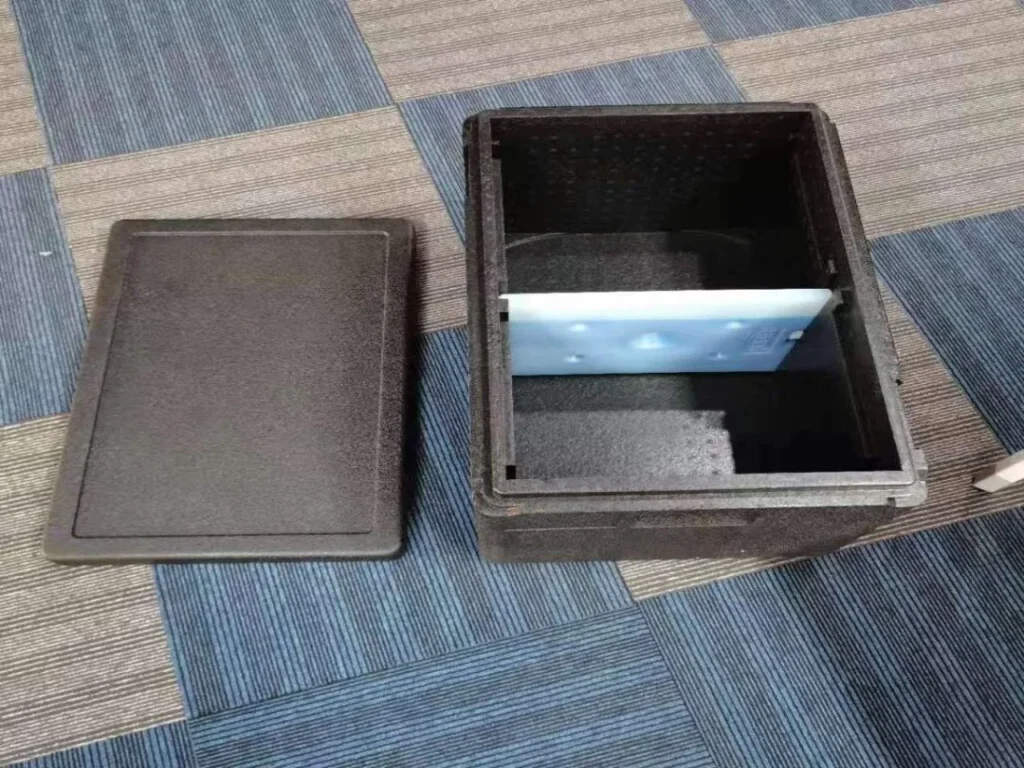
EPP insulation boxes serve diverse markets:
| Industry | Application | Critical Requirements |
|---|---|---|
| Pharmaceutical | Vaccine transport, clinical trial materials | Temperature stability, validation, cleanability |
| Food & Beverage | Seafood, produce, meal kit delivery | Food contact safety, durability |
| Medical | Organ transport, specimen shipping | Sterilization compatibility, impact protection |
| E-commerce | Temperature-controlled home delivery | Lightweight, branding surface |
| Industrial | Chemical transport, temperature-sensitive components | Chemical resistance, durability |
Common Production Issues
| Issue | Likely Cause | Solution |
|---|---|---|
| Surface voids/pitting | Inadequate venting, steam too aggressive | Adjust vent design, reduce steam pressure |
| Poor fusion/weak boxes | Insufficient steam temperature, under-aged beads | Increase steam parameters, verify aging time |
| Post-molding shrinkage | Insufficient annealing, premature demolding | Extend annealing, verify cooling parameters |
| Dimensional variation | Inconsistent fill, mold temperature variation | Calibrate fill system, verify mold thermal uniformity |
| Warpage | Uneven cooling, premature demolding | Balance cooling, extend mold residence time |
| Surface discoloration | Steam too hot, excessive cycle time | Reduce temperature, optimize cycle |
| Sticking in mold | Insufficient draft, mold surface issue | Check mold design, verify release agents |
Conclusion
The production process of EPP insulation boxes represents a sophisticated integration of material science, precision engineering, and process control.
As cold chain logistics continues to expand globally—driven by pharmaceutical requirements, food safety regulations, and e-commerce growth—the demand for high-quality EPP insulation boxes will only increase.
Whether protecting life-saving vaccines, preserving fresh seafood, or enabling temperature-controlled home delivery, EPP insulation boxes manufactured through this sophisticated process play an essential role in the modern economy—keeping sensitive products at the right temperature, from production to destination.