
In the world of foam packaging, insulation, and protective components, three materials dominate the landscape: EPS (Expanded Polystyrene), EPP (Expanded Polypropylene), and EPE (Expanded Polyethylene).
While they share similar production origins—all are expanded polymer foams created through bead fusion or extrusion processes—their chemical structures, mechanical properties, and ideal applications differ dramatically.
Understanding these differences is essential for engineers, packaging designers, procurement specialists, and anyone involved in selecting materials for protective packaging, thermal insulation, automotive components, or consumer goods.
What Are EPS, EPP, and EPE?
All three materials belong to the family of closed-cell thermoplastic foams, but they start from fundamentally different base polymers:
| Material | Full Name | Base Polymer | Resin Code | Common Trade Names |
|---|---|---|---|---|
| EPS | Expanded Polystyrene | Polystyrene | #6 | Styropor®, Styrofoam™ (trademark), airpop® |
| EPP | Expanded Polypropylene | Polypropylene | #5 | ARPRO®, EPERAN®, Neopolen® |
| EPE | Expanded Polyethylene | Polyethylene | #4 | PROTEClitelon®, Ethafoam™ |
Each material begins as small solid beads that are expanded using heat and pressure, then molded or formed into final shapes.
However, the differences in their base chemistry create dramatically different performance characteristics that determine their suitability for specific applications .
Expanded Polystyrene (EPS)
What Is EPS?
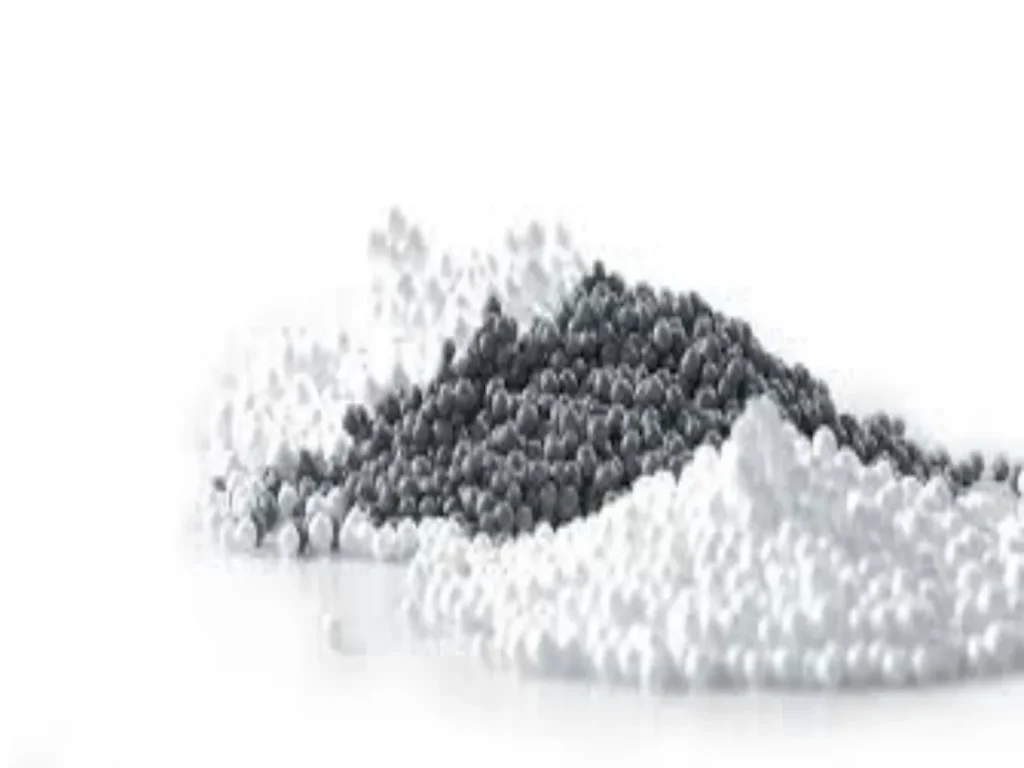
EPS is a rigid, closed-cell thermoplastic foam made from polystyrene resin.
It’s the most common and widely recognized of the three materials, often mistakenly called “Styrofoam” (which is actually a specific Dow Chemical trademark for extruded polystyrene used in insulation) .
The material consists of approximately 98% air and only 2% polystyrene, making it exceptionally lightweight and resource-efficient to produce .
Manufacturing Process
The production of EPS follows a three-stage process :
- Pre-expansion: Polystyrene beads containing a blowing agent (typically pentane) are heated with steam above 90°C, causing them to expand 20-50 times their original volume
- Maturing/Stabilization: Expanded beads are stored for 6-12 hours to reach equilibrium pressure
- Molding: Beads are conveyed to molds where additional steam fuses them into final shapes—either large blocks (for cutting into sheets) or custom-molded parts
Key Properties of EPS
| Property | Typical Value/Range |
|---|---|
| Density | 10-200 kg/m³ (standard: 15-35 kg/m³) |
| Thermal Conductivity | 0.030-0.040 W/mK (at 10°C for 20 kg/m³) |
| Compressive Strength | 30-650 kPa (at 10% deformation, density-dependent) |
| Maximum Service Temperature | 75-85°C (long-term) |
| Minimum Service Temperature | -40°C |
| Water Absorption | Low (closed-cell structure) |
Advantages of EPS
- Excellent thermal insulation: Very low thermal conductivity makes it ideal for building insulation and cold chain packaging
- Lightweight: 98% air content reduces transportation costs and emissions
- Cost-effective: Most affordable among the three materials
- Good compressive strength: Holds up well under static loads
- Energy-absorbing: Excellent cushioning for sensitive goods
- Food-safe: Suitable for direct food contact
- Recyclable: 100% recyclable with established take-back systems
Limitations of EPS
- Brittle: Cracks rather than flexes under impact; permanent deformation after energy absorption
- Poor chemical resistance: Readily attacked by organic solvents (gasoline, acetone)
- UV sensitive: Surface yellows and becomes brittle with prolonged sunlight exposure
- Temperature limited: Softens above 80°C; not suitable for high-temperature applications
- Single-impact use: Designed for one-time energy absorption (helmets must be replaced after impact)
Common EPS Applications
Packaging:
- Protective packaging for electronics, appliances, and white goods
- Cold chain shipping containers for vaccines and organs
- Food service containers (cups, trays, clamshells)
- Fruit and vegetable trays
Construction:
- Building insulation boards and facade elements
- Insulated concrete forms (ICFs)
- Lightweight fill in road and railway construction
Safety:
- Helmet crash elements (bicycle, motorcycle, ski helmets)
- Automotive crash cushions
Other:
- Buoyancy chambers for pontoons and marinas
- Lost foam casting patterns
- Installation molded parts
Expanded Polypropylene (EPP)
What Is EPP?
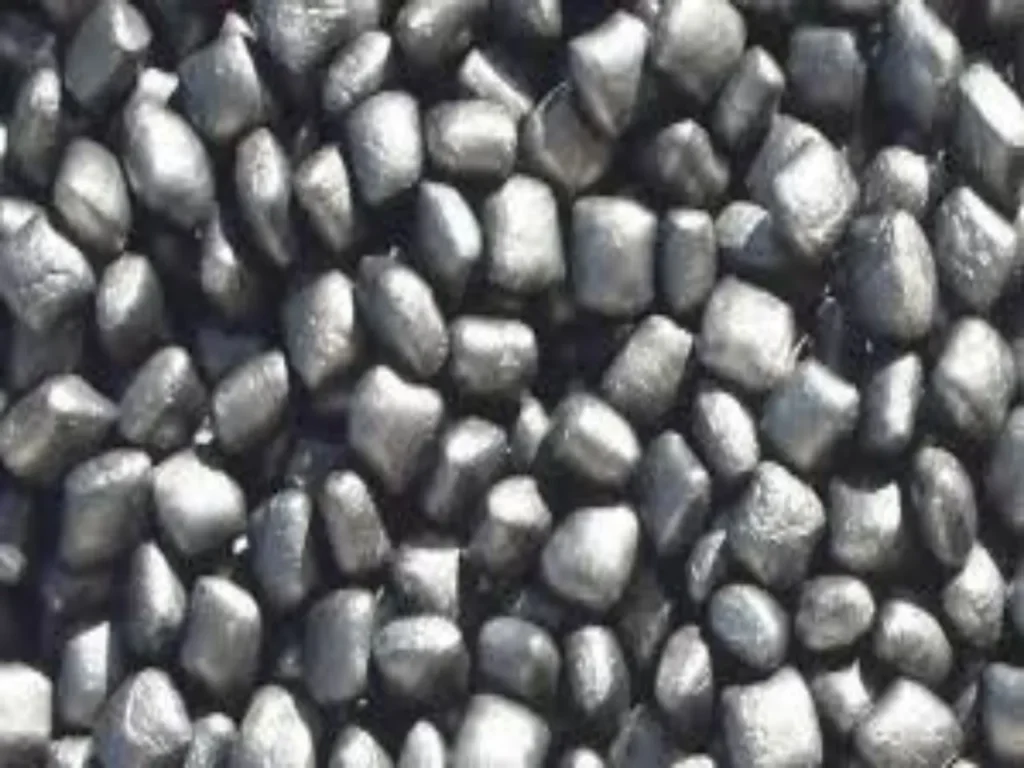
EPP is a highly versatile closed-cell bead foam made from polypropylene resin. Unlike EPS, EPP offers exceptional resilience and multiple-impact resistance—it absorbs energy and then returns to its original shape .
Developed in the 1970s and first commercialized for automotive applications in Japan in 1982, EPP has become the material of choice for reusable packaging, automotive safety components, and premium consumer goods .
Manufacturing Process
EPP production requires specialized technical expertise :
- Bead formation: Polypropylene resin undergoes a multi-step proprietary process to create precisely shaped expanded beads
- Steam-chest molding: Beads are injected into aluminum molds
- Fusion: Pressure and steam heat fuse the beads into finished shapes
- Cooling: Controlled cooling stabilizes the final part
Key Properties of EPP
| Property | Typical Value/Range |
|---|---|
| Density | 15-230 kg/m³ |
| Thermal Conductivity | 0.035-0.045 W/mK |
| Compressive Strength (25% strain) | 80-2000 kPa (density-dependent) |
| Maximum Service Temperature | 110-130°C |
| Minimum Service Temperature | -40°C |
| Water Absorption | <0.5% by volume |
Advantages of EPP
- Superior impact resistance: Excellent energy absorption with multiple-impact capability
- Resilience: Recovers after compression; elastic return to shape
- Durability: Maintains properties after repeated use
- Chemical resistance: Resists oils, gasoline, acids, and alkalis
- Temperature stability: Wide service temperature range (-40°C to +130°C)
- Lightweight: High strength-to-weight ratio
- Food-safe: Approved for food contact; does not support microbial growth
- Recyclable: 100% recyclable (Type 5)
- Multiple grades available: Anti-static, conductive, flame-retardant, and low-emission options
Limitations of EPP
- Higher cost: More expensive than EPS (typically 2-3x)
- Longer cycle times: Molding requires extended cooling periods
- Surface finish: Can have a beadier appearance than EPS
- Bonding challenges: Difficult to bond with adhesives without special techniques
Common EPP Applications
Automotive (the largest market) :
- Bumper cores and energy absorbers
- Seating components, headrests, armrests
- Door panels, pillars, parcel shelves
- Stowage systems and tool kits
- Sun visors and interior trim
Reusable Packaging :
- Returnable industrial dunnage
- Protective cases for sensitive instruments
- Reusable shipping containers
- Transit packaging for automotive parts
Consumer Goods :
- Premium coolers and insulated food delivery containers
- Toy components (model aircraft, play structures)
- Furniture components
- Sports equipment padding
Industrial:
- Thermal insulation in demanding environments
- Acoustic insulation applications
- Buoyancy and flotation devices
Expanded Polyethylene (EPE)
What Is EPE?
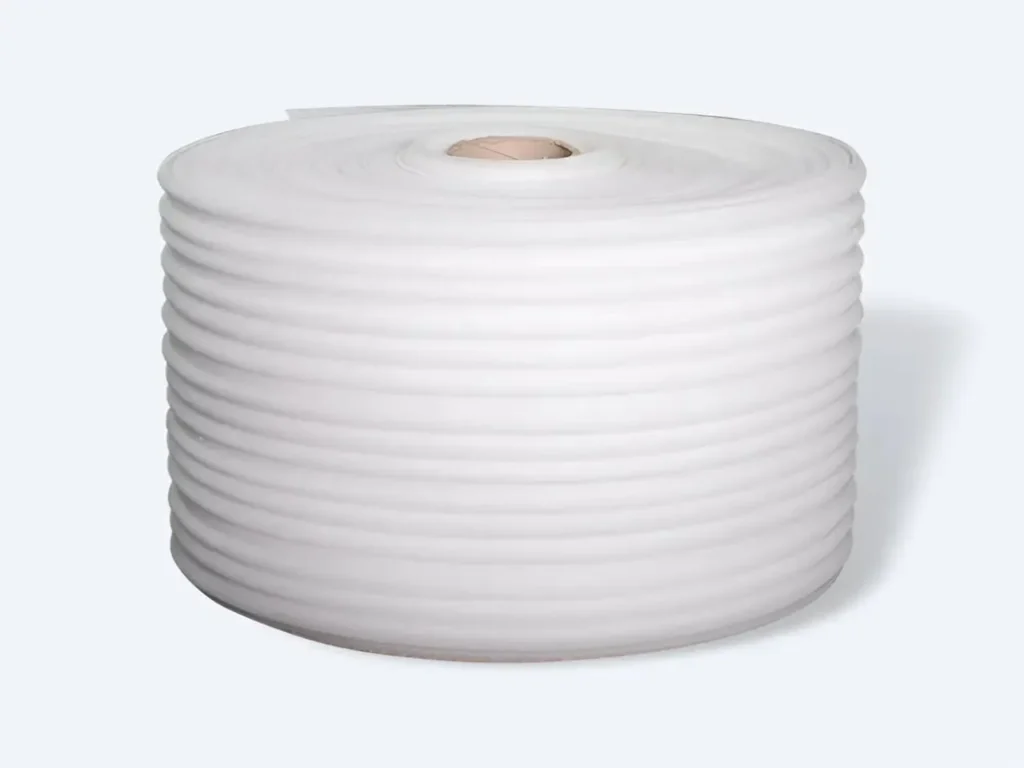
EPE is a flexible, closed-cell foam made from polyethylene resin. It offers a unique balance of flexibility, cushioning, and chemical resistance, bridging the gap between rigid EPS and resilient EPP .
Manufacturing Process
EPE can be produced through several methods:
- Extrusion: Polyethylene resin is melted, mixed with blowing agent, and extruded through a die
- Sheet formation: Produced as continuous sheets, rolls, or planks
- Fabrication: Cut, laminated, or formed into final shapes
Key Properties of EPE
| Property | Typical Value/Range |
|---|---|
| Density | 20-200 kg/m³ |
| Thermal Conductivity | 0.035-0.048 W/mK |
| Compressive Strength | 20-200 kPa (at 25% deformation) |
| Maximum Service Temperature | 70-80°C |
| Minimum Service Temperature | -40°C to -60°C |
| Water Absorption | <0.1% by volume |
| Flexibility | Highly flexible and elastic |
Advantages of EPE
- Excellent flexibility: Conforms to shapes, wraps easily around products
- High tear strength: Superior tear resistance compared to EPS
- Low water absorption: Nearly impervious to moisture
- Chemical resistance: Resists acids, alkalis, and many chemicals
- Non-abrasive: Soft surface won’t scratch delicate items
- Temperature flexibility: Maintains flexibility at low temperatures
- Non-toxic and odorless: Safe for sensitive applications
- CFC-free and recyclable: Environmentally friendly
- Anti-static grades available: For electronics packaging
Limitations of EPE
- Lower structural strength: Not as rigid as EPS or EPP for load-bearing
- Limited thermal insulation: Slightly lower R-value than EPS
- Creep under sustained load: May deform under continuous pressure
- Temperature limited: Lower maximum temperature than EPP (70-80°C)
- Bonding challenges: Difficult to bond without specialized adhesives
Common EPE Applications
Packaging :
- Surface protection sheets and films
- Foam wraps and rolls
- Interleaving for glass, electronics
- Corner protectors and edge guards
- Packaging for auto spare parts
Sports and Leisure :
- Yoga mats, exercise mats
- Pool noodles and flotation devices
- Camping mats, sleeping pads
- Garment inserts and bag padding
Consumer Products :
- Mattress cores and toppers
- Carpet underlays
- Craft foam
- Toy components (EVA foam toys)
Industrial :
- Gasketing and sealing
- Vibration isolation pads
- Case liners
Direct Comparison: EPS vs. EPP vs. EPE
Physical Properties Comparison
| Property | EPS | EPP | EPE |
|---|---|---|---|
| Base Polymer | Polystyrene | Polypropylene | Polyethylene |
| Resin Code | #6 (PS) | #5 (PP) | #4 (PE) |
| Cell Structure | Closed-cell | Closed-cell | Closed-cell |
| Rigidity | Rigid | Semi-rigid | Flexible |
| Surface Feel | Hard, smooth | Smooth, slightly tacky | Soft, waxy |
| Color Range | White (natural), custom colors | White, black, gray, vibrant colors | White, pink, blue, custom |
Mechanical Properties Comparison
| Property | EPS | EPP | EPE |
|---|---|---|---|
| Compressive Strength | Good (highest at equal density) | Good | Moderate |
| Impact Resistance | Low (brittle, single-impact) | Excellent (multiple-impact) | Good (cushioning) |
| Recovery After Compression | Poor (plastic deformation) | Excellent (elastic recovery) | Good |
| Flexibility | None | Moderate | Excellent |
| Tear Strength | Low | Good | Excellent |
Thermal Properties Comparison
| Property | EPS | EPP | EPE |
|---|---|---|---|
| Thermal Conductivity (W/mK) | 0.030-0.040 | 0.035-0.045 | 0.035-0.048 |
| Max Service Temperature (°C) | 75-85 | 110-130 | 70-80 |
| Min Service Temperature (°C) | -40 | -40 | -40 to -60 |
| Thermal Stability | Good | Excellent | Good |
Chemical Resistance Comparison
| Substance | EPS | EPP | EPE |
|---|---|---|---|
| Water | Excellent | Excellent | Excellent |
| Oils/Gasoline | Poor (dissolves) | Good (slight swelling) | Good |
| Solvents (acetone, toluene) | Poor (dissolves) | Good (slight swelling) | Good |
| Acids (10%) | Good | Excellent (no change) | Excellent |
| Alkalis (10%) | Good | Excellent (no change) | Excellent |
| Alcohol | Good | Excellent | Excellent |
Environmental Comparison
| Factor | EPS | EPP | EPE |
|---|---|---|---|
| Recyclability | 100% recyclable (#6) | 100% recyclable (#5) | 100% recyclable (#4) |
| Recycled Content Available | Yes | Yes | Yes |
| Biodegradability | No | No | No |
| Production Energy | Low (steam expansion) | Moderate | Moderate |
| Blowing Agent | Pentane (hydrocarbon) | CO₂ physical foaming | Chemical agents |
| Reuse Potential | Limited (single-use typical) | High (multiple cycles) | Moderate |
Why the Differences Matter
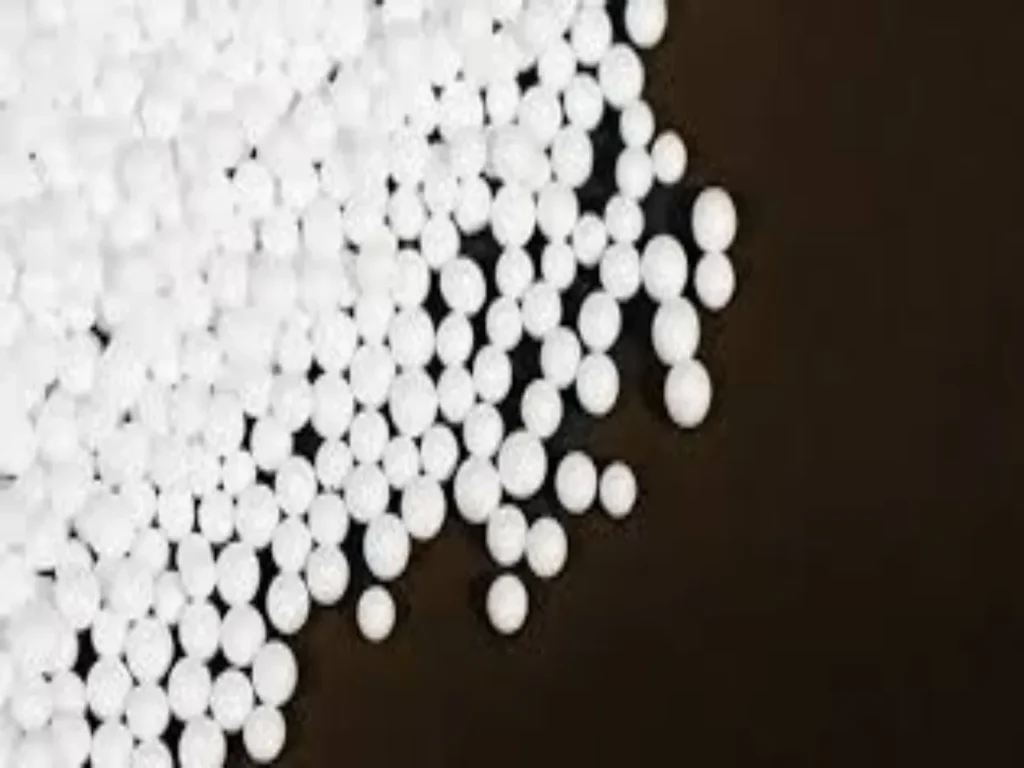
The Chemistry Behind the Differences
The three materials differ at the molecular level, which explains their distinct behaviors :
EPS (Polystyrene):
- Polymer chain: Aromatic rings attached to carbon backbone
- Structure: Rigid, bulky side groups prevent chain movement
- Result: Hard, brittle material at room temperature
- Glass transition temperature (Tg): ~100°C (above room temp, so rigid)
- Energy absorption mechanism: Cell wall fracture (single-use)
EPP (Polypropylene):
- Polymer chain: Simple hydrocarbon (CH₂-CH-CH₃)n
- Structure: Semi-crystalline with both amorphous and crystalline regions
- Result: Flexible but strong, good elastic recovery
- Melting point: ~160°C (crystalline regions provide heat resistance)
- Energy absorption mechanism: Cell wall bending and elastic deformation (reusable)
EPE (Polyethylene):
- Polymer chain: Simple hydrocarbon (CH₂-CH₂)n
- Structure: Varies by density (LDPE, LLDPE)
- Result: Flexible, soft, excellent low-temperature properties
- Melting point: 105-115°C (LDPE)
- Energy absorption mechanism: Cell compression and air movement (cushioning)
Temperature Resistance Explained
The temperature capabilities differ due to polymer structure :
- EPS: Limited to ~80°C because polystyrene softens near its glass transition temperature
- EPE: Limited to ~70-80°C because polyethylene begins to soften
- EPP: Can withstand 120°C due to polypropylene’s higher melting point and crystalline structure
In practical terms, this means:
- EPP automotive components can withstand summer heat inside cars
- EPS coolers perform well but cannot be dishwashed
- EPE yoga mats may deform if left in hot cars
Cost Considerations and Economic Analysis
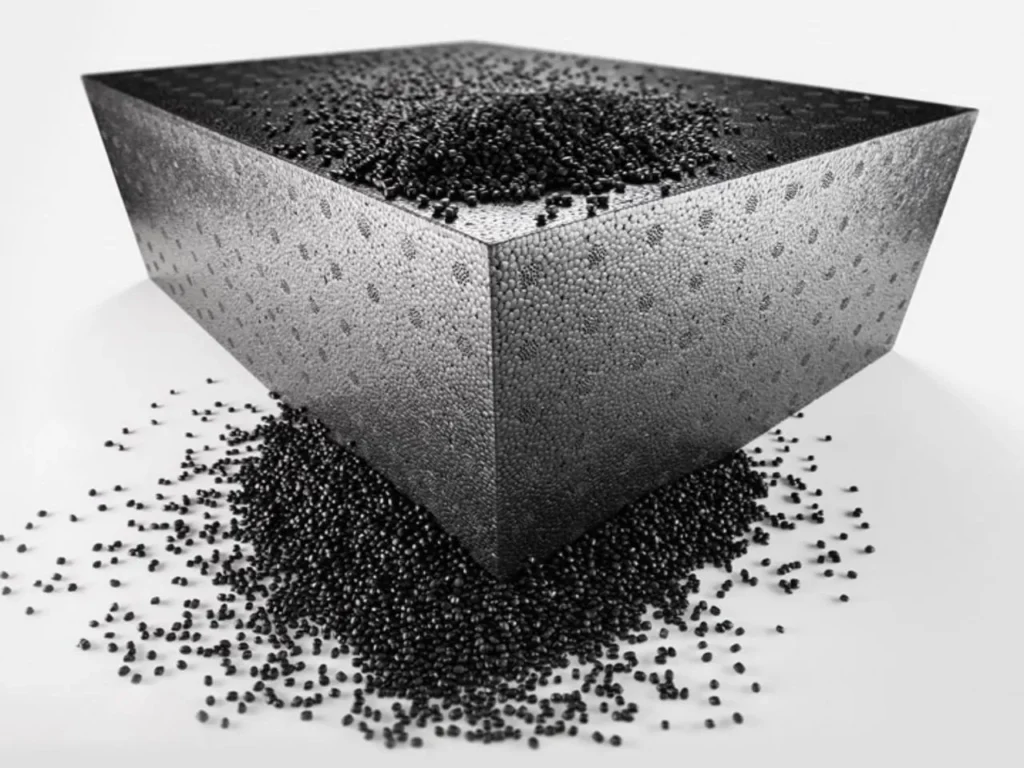
Understanding the cost implications helps in material selection :
| Factor | EPS | EPP | EPE |
|---|---|---|---|
| Raw Material Cost (per kg) | Lowest | 2-3x EPS | 1.5-2x EPS |
| Tooling Cost | Moderate | Higher (longer cooling) | Lower (for sheet/roll) |
| Cycle Time | Fast (1-3 min) | Slower (2-5 min) | Continuous (extrusion) |
| Per-Part Cost (low volume) | Low | High | Moderate |
| Per-Part Cost (high volume) | Very low | Moderate | Low |
Economic Insight :
- EPS dominates single-use applications where cost is paramount (construction insulation, disposable packaging)
- EPP justifies its premium in reusable systems—the higher upfront cost is offset by durability over multiple cycles
- EPE offers mid-range economics for applications requiring flexibility and surface protection
For building insulation specifically, EPS runs approximately $2-$4 per square foot, making it the most affordable rigid foam insulation on the market .
Conclusion: Making the Right Choice
The choice between EPS, EPP, and EPE ultimately depends on your specific requirements:
| If You Need… | Choose… |
|---|---|
| Lowest cost, single-use, rigid insulation | EPS |
| Reusable packaging, multiple-impact protection | EPP |
| Flexibility, surface protection, conformability | EPE |
| High-temperature exposure (up to 130°C) | EPP |
| Food contact, single-use disposables | EPS |
| Food contact, reusable containers | EPP |
| Automotive components | EPP |
| Building insulation | EPS |
| Yoga mats, flotation devices | EPE |
| Chemical/oil resistance | EPP or EPE |
Key Takeaways
- EPS is the rigid, cost-effective workhorse for single-use packaging, construction insulation, and applications requiring static load support and thermal insulation at minimal cost.
- EPP is the resilient, durable survivor for reusable systems, automotive safety components, and applications where multiple-impact protection and long service life justify higher initial investment.
- EPE is the flexible, conformable all-rounder for surface protection, wrapping applications, and situations where soft cushioning and tear resistance are paramount.
- All three are fully recyclable, but their end-of-life infrastructure varies—EPP offers the strongest circular economy potential due to its durability and established recycling channels.
- Temperature matters—choose EPP for hot environments, EPS for standard conditions, and EPE for cold flexibility.
By understanding these fundamental differences, you can select the best foam material—balancing performance, cost, and sustainability—to create better products and packaging systems that meet your needs.