
As urban populations swell and the climate crisis intensifies, the demand for housing that is both affordable and thermally efficient has reached an all-time high.
Traditional timber-frame or brick-and-mortar construction often fails to meet the stringent requirements of modern energy codes and disaster resilience.
Enter Insulated Concrete Forms (ICF)—a high-performance building system that acts as the “Lego” of the construction world.
However, the secret to a successful ICF building doesn’t start on the construction site; it starts in the icf molds used to manufacture the blocks.
Understanding the ICF System
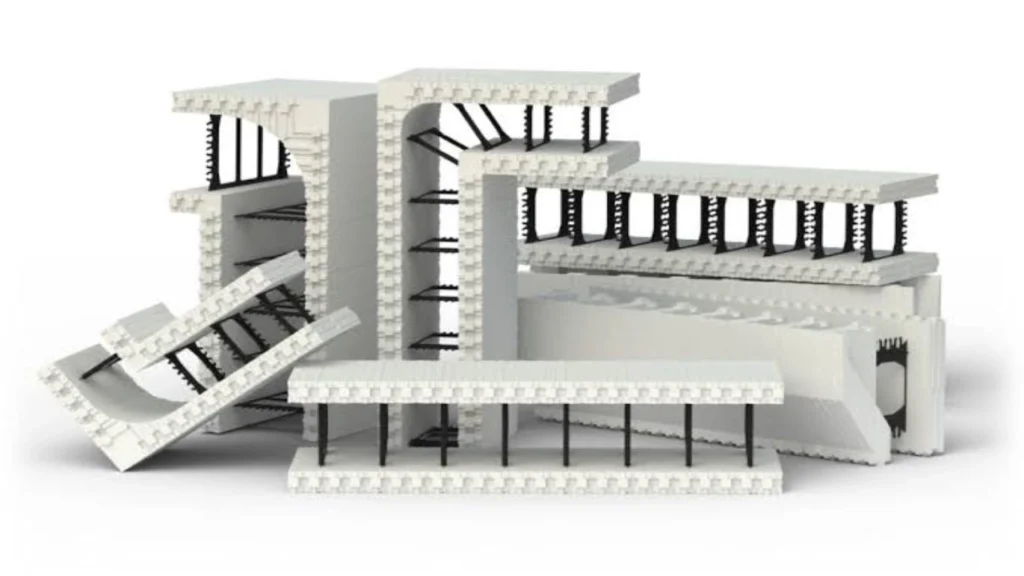
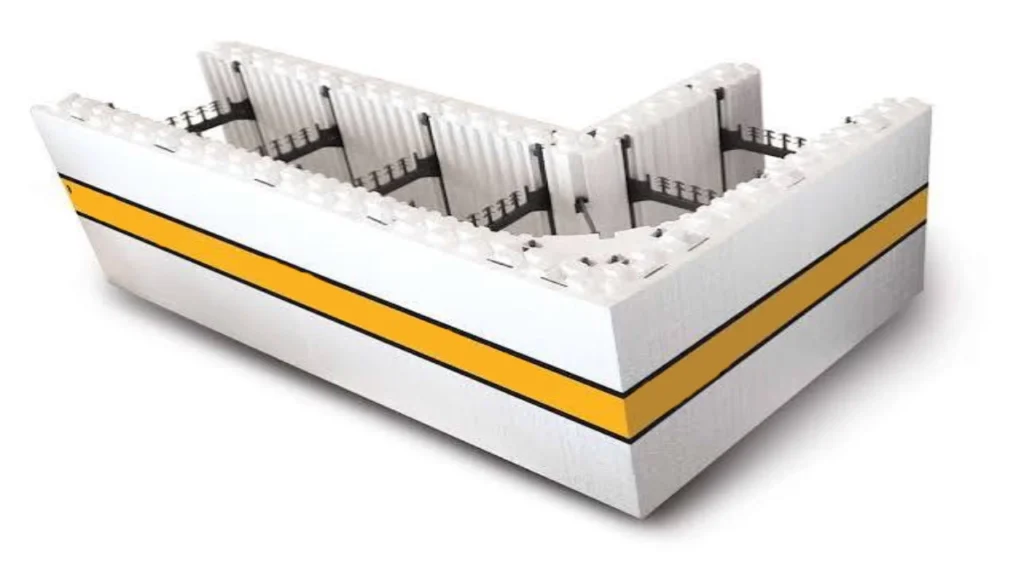
Insulated Concrete Forms (ICF) are hollow blocks or panels made of high-density Expanded Polystyrene (EPS) that are stacked to create the shape of a building’s walls.
Once stacked, the hollow core is filled with reinforced concrete.
The Dual Function of the ICF Block
- Permanent Formwork: During construction, the blocks act as a rigid mold for the poured concrete.
- Double-Layer Insulation: Post-construction, the EPS remains in place, providing a continuous thermal envelope on both the interior and exterior of the wall.
Why EPS is the Perfect Medium
As discussed in our technical guide on EPS foam vs. Styrofoam, EPS is a closed-cell material composed of 98% air. This structure makes it an extraordinary thermal insulator.
When molded using high-precision ICF Molds, these blocks can achieve R-values (thermal resistance) ranging from R-22 to R-50+, far exceeding traditional wall assemblies.
Engineering the Perfect ICF Mold
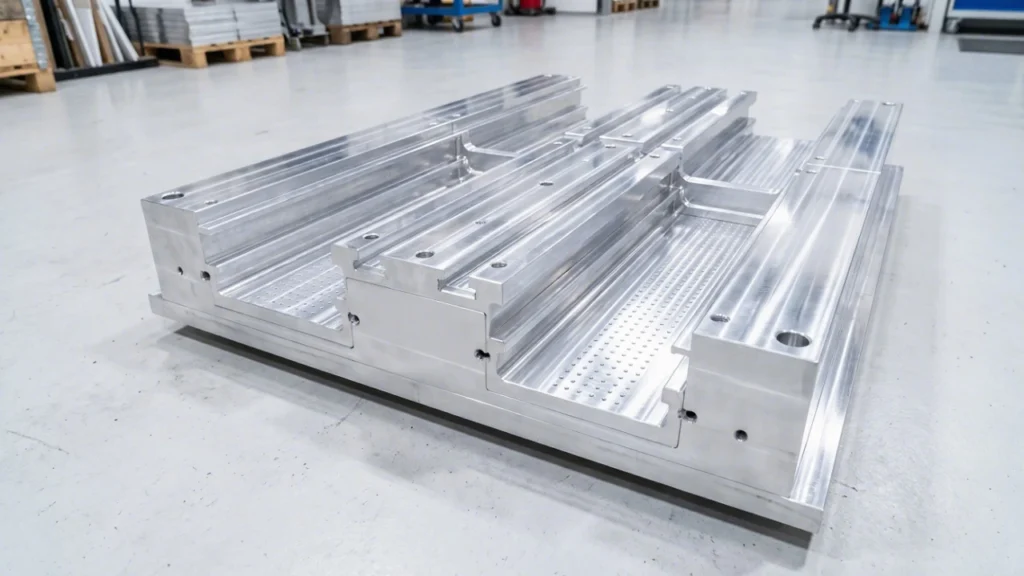
A sustainable building is only as good as its airtightness. If the ICF blocks don’t fit together perfectly, you create thermal bridges—micro-gaps where heat escapes and energy efficiency dies.
This is why the engineering of the mold is the most critical link in the chain.
A. The Interlocking Mechanism (The “Tension-Fit”)
The top and bottom of an ICF block feature a “knob” or “interlocking” pattern.
- The Challenge: These knobs must fit with a tolerance of less than 0.5mm. If the fit is too loose, the wall will “creep” or lean during the concrete pour (a phenomenon known as “blowout”). If the fit is too tight, the blocks will crack during assembly.
- The Solution: At Foamold, we utilize 5-axis CNC machining to carve the interlocking patterns directly into the aluminum mold blocks. This ensures that every block produced is an exact replica of the master CAD file, guaranteeing structural stability on-site.
B. Internal Web & Insert Integration
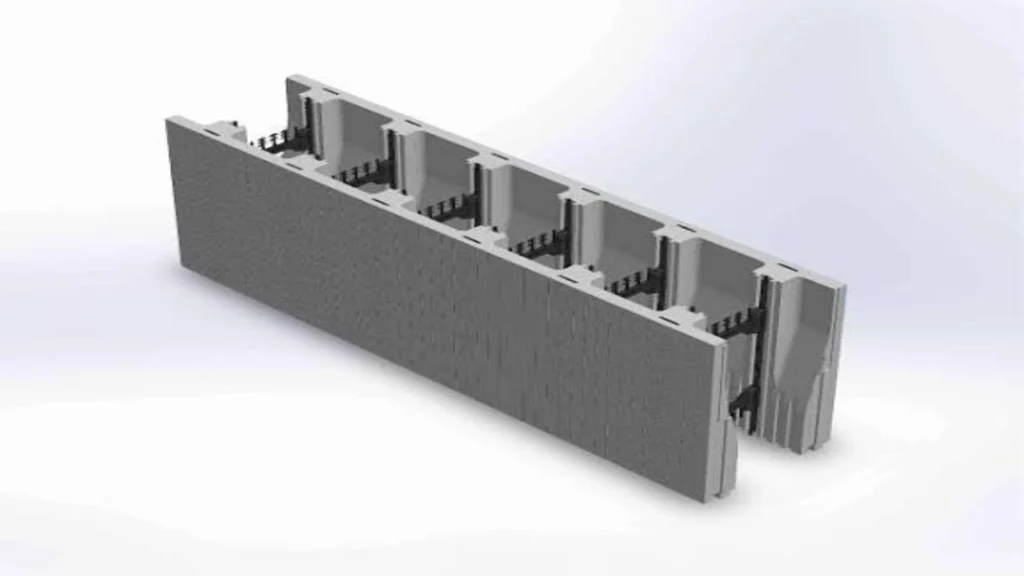
Modern ICF blocks are not just foam; they often contain integrated plastic webs (or “ties”) that hold the two foam layers together and provide a secure attachment point for drywall or siding.
- Insert Molding: The ICF mold must be engineered to hold these plastic inserts in place during the high-pressure steam injection process. This requires specialized “retention pins” within the mold cavity that can withstand the EPS manufacturing process without warping.
C. Surface Texture for Adhesion
A common pain point for contractors is getting stucco or plaster to stick to EPS.
- Technology: We engineer waffle-patterns or tapered grooves into the interior surface of the mold. These textures are transferred to the EPS block, creating a mechanical bond for finishing materials, reducing the need for expensive chemical adhesives and furthering the sustainability of the build.
The Environmental Impact of ICF Molds
Sustainable construction is measured in two ways: Embodied Carbon (the energy required to build) and Operational Carbon (the energy required to run the building).
A. Slashing Operational Carbon
A building’s heating and cooling account for roughly 40% of global energy consumption. ICF buildings can reduce these costs by 50% to 70%.
- Thermal Mass: The concrete core within the EPS mold-formed blocks acts as a thermal battery, smoothing out temperature spikes. This reduces the size and cost of the HVAC system required for the building.
B. Embodied Carbon and Recyclability
Critics often point to the plastic nature of EPS. However, the narrative is changing:
- Lifecycle ROI: An ICF building is designed to last 100+ years. The carbon saved through energy efficiency over a century far outweighs the initial carbon footprint of the EPS production.
- Recyclability: Modern ICF molds are designed to work with a percentage of recycled EPS content. At Foamold, we optimize our venting systems to ensure that molds can handle reground EPS beads, allowing manufacturers to close the loop on waste.
The Unseen Benefit of Sustainability
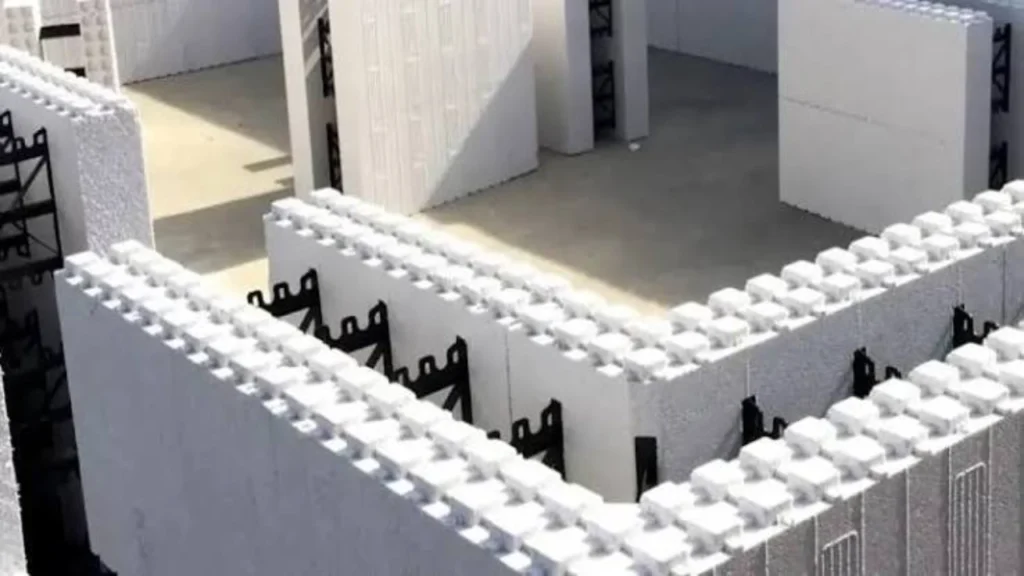
True sustainability includes Resilience. A building that is destroyed by a hurricane is the ultimate environmental waste.
A. High-Wind Resistance
ICF walls formed by precision molds are rated to withstand winds of up to 250 mph (400 kph). They are increasingly used in “Tornado Alleys” in the US and hurricane zones in the Caribbean.
B. Fire Safety
EPS is often misunderstood regarding fire. The EPS used in ICF molds contains flame retardants. When combined with the solid concrete core, ICF walls achieve a 4-hour fire rating.
This means a fire in one unit of an ICF apartment complex is much less likely to spread to the next, saving lives and infrastructure.
Global Market Dynamics
As a leading supplier with significant market share in Africa (30%) and South America (25%), we have observed a massive shift toward ICF for several strategic reasons.
A. Overcoming Labor Shortages
Building a traditional brick wall requires skilled masons. Stacking ICF blocks requires significantly less specialized labor.
An unskilled team can be trained to stack a house’s walls in just a few days, accelerating development in rapidly urbanizing regions.
B. Resistance to Termites and Rot
In tropical climates, wood-frame houses are vulnerable to termites and moisture-related rot.
ICF is inorganic. Neither termites nor mold (fungi) can feed on EPS or concrete, making it the most durable solution for hot, humid environments.
C. Thermal Protection Against Extreme Heat
In many African regions, the focus is not on keeping heat in, but keeping it out.
The continuous insulation of ICF blocks prevents the intense daytime sun from penetrating the interior, significantly improving comfort without relying on expensive air conditioning.
The ROI of Owning ICF Molds
For real estate developers and government housing authorities, the question is often: Should we buy the blocks or buy the molds?
The “Localized Production” Advantage
If you are planning a project of more than 500 homes, importing or buying blocks from a third party is inefficient.
- Reduced Logistics Costs: Transporting EPS blocks is like “shipping air.” By owning your own ICF Molds and setting up a local production line, you only ship the raw beads (which are compact) and manufacture the blocks on-site or nearby.
- Customization: Owning the molds allows you to create specific block heights and interlocking patterns tailored to the local building codes of your region.
Payback Period
A high-quality aluminum ICF mold from Foamold can produce 80,000 to 120,000 blocks before requiring significant maintenance.
Depending on local market prices, the mold typically pays for itself within the first 3 to 6 months of full-scale production.
Common Questions About ICF Molds
What material is used to manufacture industrial ICF molds?
ICF molds (the tooling used in factories to produce foam blocks) are primarily machined from high-grade 6061-T6 aluminum forged alloy or cast aluminum. Aluminum is selected for its high thermal conductivity—critical for rapid steam heating and water cooling—and its structural rigidity against repeated hydraulic clamping forces.
How do manufacturers achieve the interlocking teeth and structural tie encapsulation?
ICF shape molding machines utilize insert-molding techniques. High-density plastic ties (typically recycled polypropylene) are placed into precise core pins inside the aluminum mold cavity before closure. EPS raw beads are then injected, pressure-steamed to expand and fuse, and cooled. The expanding EPS encapsulates the web flanges directly inside the foam wall.
How do you attach drywall and exterior cladding to ICF walls?
ICF blocks feature embedded high-density plastic webs spaced every 6 to 8 inches on center, positioned roughly $1/2\text{ inch}$ below the foam surface. Trades drive standard drywall screws or exterior fasteners directly into these marked furring strips, which offer pull-out strength comparable to traditional wood studs.
How are electrical wiring and plumbing installed in foam blocks?
Trades do not drill into the concrete core for standard utilities. Instead, electrician and plumbing crews use a hot-knife tool or electric wall-chaser to melt channels directly into the $2.5\text{ inch}$ EPS foam panels. Romex wire or PEX tubing is pressed into these channels, and junction boxes are anchored to the internal plastic webs.
Do ICF molds require bracing during the concrete pour?
Yes. Temporary alignment bracing (wall-turnbuckle systems) is installed on the interior perimeter before pouring. This bracing ensures the stacked blocks remain plumb, level, and straight while bearing the fluid pressure (hydrostatic head) of wet concrete poured via boom pump.
Conclusion
Sustainable construction is no longer a luxury; it is a global necessity.
Insulated Concrete Forms represent the most logical path toward carbon-neutral, disaster-resilient housing.
But this path begins with the precision of the mold.
At Foamold (Transfoam), we are proud to be the engineering force behind thousands of sustainable building projects worldwide.
From the initial DFM (Design for Manufacturability) to the final CMM-inspected aluminum tool, we ensure that every ICF mold we produce contributes to a safer, more efficient, and greener world.
Ready to lead the green building revolution? Whether you are a developer in South America or a government agency in Africa, our technical team is ready to help you plan your ICF production line.
Contact us today for a free consultation on ICF mold engineering and localized manufacturing strategies.