Moulded foam, also spelled molded foam in American English, refers to foam material that has been shaped inside a mold or forming tool to create a specific geometry, surface profile and functional structure.
Unlike simple flat foam sheets or hand-cut foam blocks, moulded foam is designed to repeat the same shape across production batches.
It is used when a product needs accurate dimensions, controlled cushioning, impact absorption, insulation, comfort, protection or assembly fit.
What Does Moulded Foam Mean?
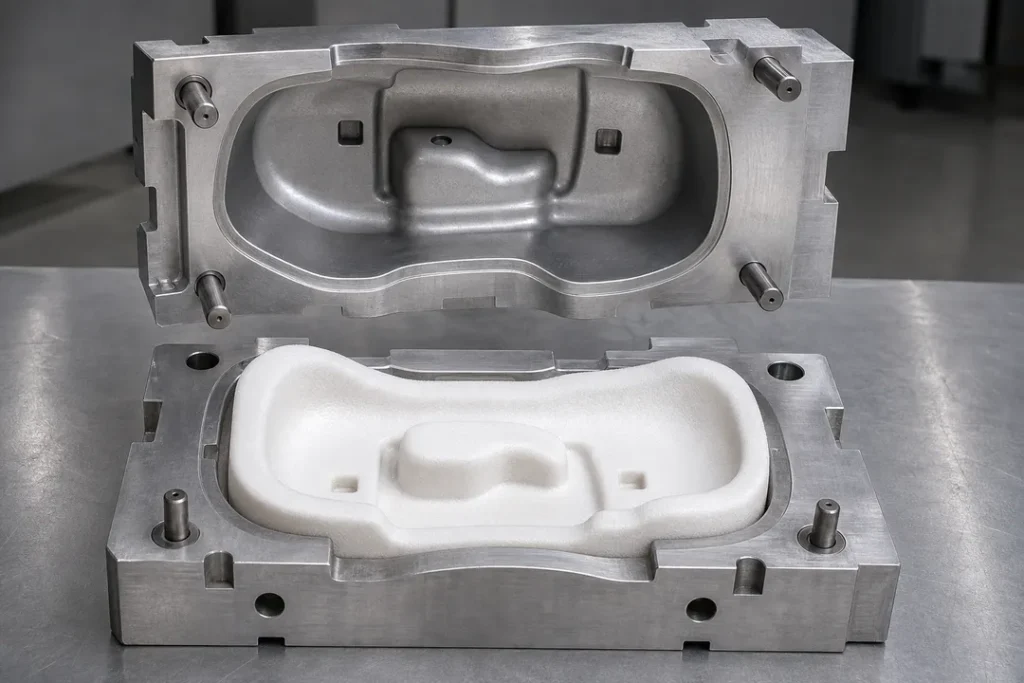
Moulded foam means foam that is formed into a defined shape by using a mold, tool or controlled forming process.
The word “moulded” indicates that the final shape is not random or only manually cut.
It is created through a repeatable manufacturing method so that every part can match the intended geometry and function.
A moulded foam product may be soft, rigid, flexible, resilient or structural depending on the material.
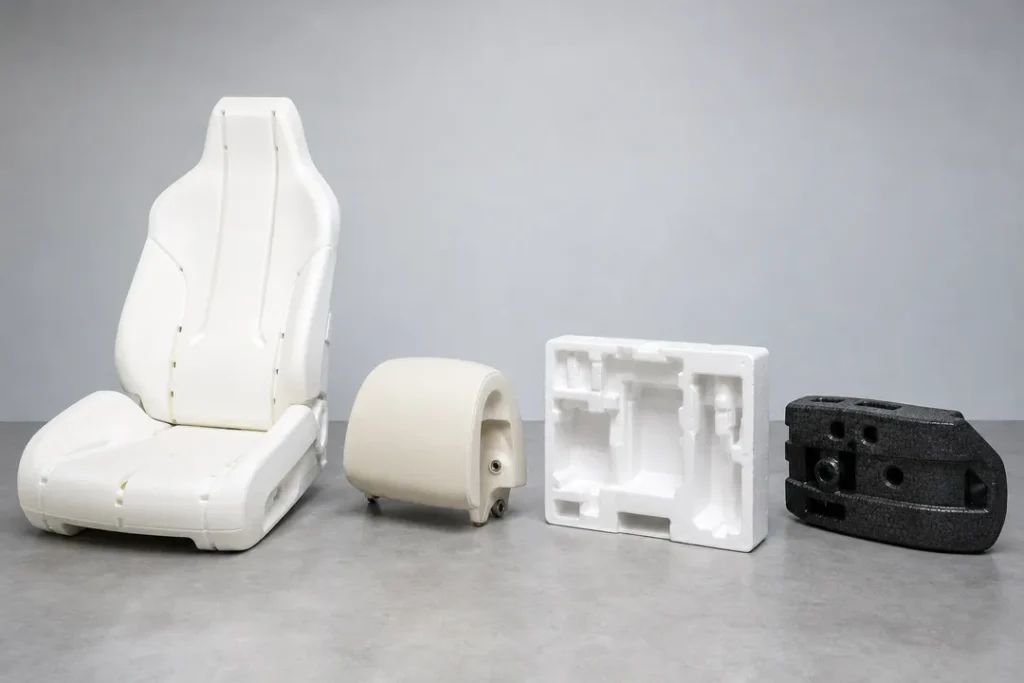
It may be made as a thin pad, a deep packaging tray, a shaped automotive absorber, a seat cushion, a helmet liner, an insulation block, a medical support part or a reusable transport insert.
The defining feature is not only that it is made of foam, but that the foam has been shaped intentionally for a specific purpose.
In manufacturing, moulded foam is often chosen when flat foam cannot meet product requirements.
A flat foam sheet may provide cushioning, but it cannot always locate a product precisely, fit a complex surface, absorb impact in a controlled direction or integrate with surrounding components.
Moulded foam solves these problems by combining material performance with three-dimensional geometry.
The term can apply to both consumer and industrial products. In consumer goods, moulded foam may appear in shoe soles, yoga products, protective cases and comfort pads.
In industrial applications, it may appear in automotive safety parts, electronics packaging, tool trays, insulation systems and logistics components.
In each case, the molded shape adds value beyond the raw foam material.
Why Moulded Foam Is Different from Cut Foam
Cut foam is made by cutting sheets, blocks or slabs into a desired outline. It is useful for simple shapes, flat pads, inserts and low-volume production.
Cutting can be done with knives, die cutting, CNC routers, waterjet systems or hot-wire equipment depending on the material.
Cut foam is flexible and cost-effective, especially when tooling investment must be kept low.
Moulded foam, however, is formed in three dimensions. It can include curves, ribs, cavities, thickness transitions, surface textures, mounting features and complex functional zones.
It is better suited when the foam part must fit another object accurately or perform a specific mechanical role.
For example, a cut foam insert may hold a rectangular product in a box.
A moulded foam insert can create a contoured cavity that supports the product at critical points, leaves clearance around delicate surfaces and absorbs impact more predictably.
This improves both protection and user experience.
The trade-off is tooling and process complexity. Cut foam often requires less tooling, while moulded foam usually requires molds, process development and more precise production control.
For small quantities or prototypes, cutting may be practical. For repeated production, complex geometry and higher performance, molding often becomes the better solution.
Common Materials Used for Moulded Foam
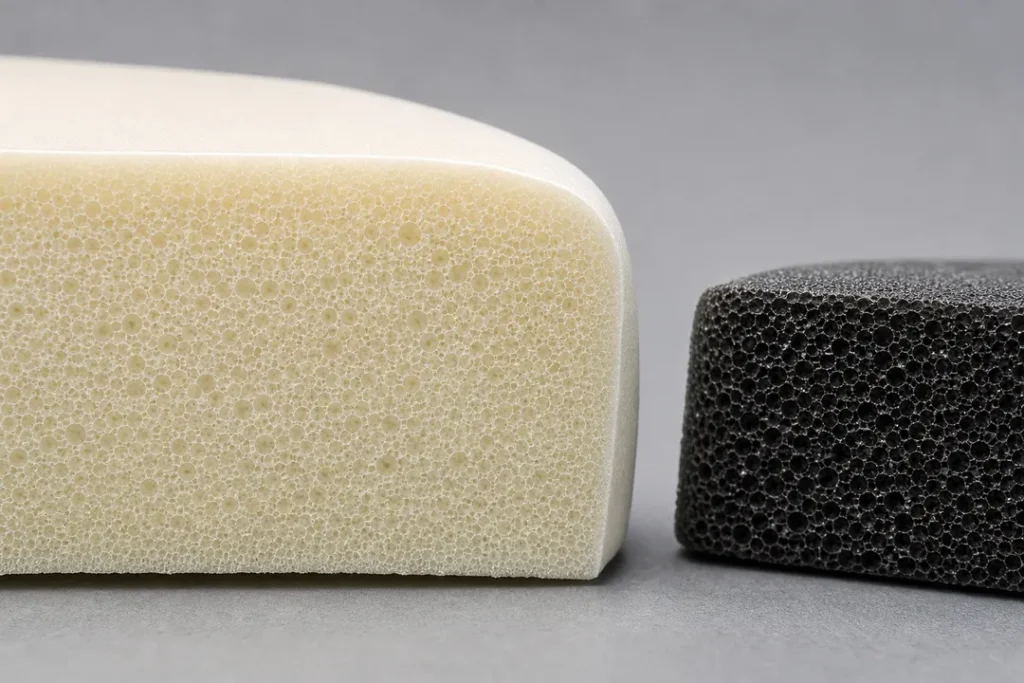
Moulded foam can be made from several material families. The most common include EPS, EPP, EVA, PE and PU. Each material has different performance characteristics and molding methods.
EPS, or expanded polystyrene, is lightweight, rigid and cost-effective. It is widely used for protective packaging, insulation boards, architectural shapes, disposable containers and shaped blocks.
EPS is usually molded from pre-expanded beads using steam. It provides good insulation and cushioning at low weight, but it is less resilient than EPP.
EPP, or expanded polypropylene, is more durable and resilient. It can recover after repeated impact and is often used for automotive components, reusable packaging, protective transport trays, safety products and high-performance cushioning.
EPP also uses bead foam molding, but it generally requires different processing conditions from EPS.
EVA foam is flexible, elastic and easy to form. It is commonly used in sports products, footwear, protective pads, molded inserts, cases and consumer goods.
EVA moulded foam is often produced by compression molding, thermoforming or injection-related processes depending on product type.
PE foam, especially cross-linked polyethylene foam, provides toughness, closed-cell performance and chemical resistance.
It is suitable for industrial pads, packaging inserts, flotation parts, insulation and protective layers. PE foam can be thermoformed, compression molded or fabricated from sheets.
PU foam, or polyurethane foam, is often used when comfort, softness and cushioning are priorities.
It appears in seating, bedding, medical supports, acoustic products and comfort pads. PU can be molded directly through chemical reaction inside a mold or fabricated from foam blocks.
EPS Moulded Foam
EPS moulded foam is one of the most widely used forms of molded foam.
It is produced from expandable polystyrene beads that are pre-expanded, aged, filled into a mold and fused with steam. After cooling, the molded part is removed from the tool.
The major advantages of EPS are low weight, thermal insulation, cost efficiency and design flexibility.
EPS can be molded into blocks, sheets, packaging inserts, protective corners, fish boxes, insulation panels and architectural decorative shapes.
Because EPS contains a high percentage of air, it delivers useful cushioning and insulation with very little material weight.
In packaging, EPS moulded foam is often used to protect appliances, electronics, machinery parts and fragile products.
The mold can be designed to support the product at specific points and create air gaps around delicate areas. This allows the packaging to absorb shock and prevent movement during transport.
In insulation, EPS moulded foam is used because of its low thermal conductivity and lightweight structure.
It can be molded or cut into panels and shapes for construction, cold-chain packaging and temperature-controlled containers.
However, EPS has limitations. It is less flexible and less impact-resilient than EPP. It may break under repeated compression or rough handling.
Therefore, it is best suited for cost-sensitive packaging, insulation and single-use or moderate-use applications where high elastic recovery is not required.
EPP Moulded Foam
EPP moulded foam is made from expanded polypropylene beads. Like EPS, it is usually produced through bead foam molding, but the final material properties are very different.
EPP is known for resilience, toughness, impact recovery and durability.
EPP is widely used in automotive safety systems, bumper absorbers, battery protection components, reusable transport packaging, tool trays, logistics containers, child safety products and protective equipment.
It is selected when the foam part must survive repeated loading or impact without losing its shape.
The molding process for EPP requires precise control of steam, pressure, temperature, venting and cooling.
Because EPP has different thermal behavior from EPS, the mold and machine conditions must be designed accordingly.
High-quality EPP molding depends strongly on mold design, bead filling, vent arrangement and process stability.
Compared with EPS, EPP usually costs more, but it offers longer service life and better mechanical performance.
For applications where failure would be expensive, such as automotive parts or reusable protective packaging, the higher material cost can be justified by improved durability.
EPP moulded foam is especially attractive for industries moving toward reusable packaging and sustainable logistics.
A single-use EPS insert may be cheaper, but a durable EPP insert can be reused many times, reducing long-term packaging waste and replacement cost.
EVA and PE Moulded Foam
EVA and PE moulded foams are commonly formed from foam sheets or blanks rather than expanded beads.
They are often heated, softened and compressed into a mold. This process can create contoured pads, protective inserts, sports guards, shoe components, case interiors and soft molded parts.
EVA foam is valued for flexibility, softness and elasticity.
It can be molded into products that need comfort and shape, such as knee pads, yoga accessories, footwear midsoles, protective case liners and molded grips.
EVA can also accept textures, colors and surface laminations.
PE foam, especially cross-linked PE, is used when toughness, closed-cell performance and chemical resistance are needed.
PE moulded foam is suitable for industrial packaging, medical supports, flotation devices, insulation pads and technical protective parts.
Compression molding of EVA and PE requires control of temperature, pressure, time and cooling. If the foam is overheated, cells may collapse.
If pressure is excessive, the part may become too hard or thin. If cooling is insufficient, the product may spring back or lose dimensional accuracy.
These materials are useful when the product requires tactile comfort, flexible movement or a smooth surface finish.
They are less suitable than EPS or EPP for thick bead-molded structures, but they are excellent for sheet-based molded foam products.
PU Moulded Foam
PU moulded foam is widely used in seating, comfort products, medical supports, furniture, automotive interiors and acoustic applications.
Unlike EPS or EPP bead foam, PU foam is often created through a chemical reaction between liquid components inside a mold. The material expands and cures into the mold shape.
Flexible PU foam is selected when softness, comfort and pressure distribution are priorities.
It can be designed with different hardness levels, densities and recovery behavior. This makes it suitable for seat cushions, back supports, armrests and comfort pads.
Rigid PU foam is used for insulation and structural support in certain applications. It can provide thermal insulation and dimensional stability.
However, it is different from flexible comfort foam and requires different formulation and processing.
PU molding depends heavily on chemistry, mold temperature, mixing ratio, curing time and ventilation.
The process must be controlled carefully because variations in formulation or processing can affect density, hardness, skin quality and long-term performance.
PU moulded foam is a strong choice for comfort-driven products, but it may not be ideal when the application requires very high impact recovery, recyclable bead foam structure or extremely lightweight rigid packaging.
Material selection should be based on function rather than general foam category.
Main Manufacturing Processes for Moulded Foam
There are several manufacturing processes for moulded foam. The most important are bead foam steam molding, compression molding, thermoforming, injection-related foam molding and reaction molding.
Bead foam molding is used for EPS and EPP. Pre-expanded beads are filled into a mold, heated with steam, fused together, cooled and ejected.
This process is excellent for lightweight three-dimensional parts, protective packaging, insulation products and automotive impact components.
Compression molding is used for foam sheets and blanks such as EVA, PE and some PU materials. The material is heated and compressed in a mold to form the desired shape.
This process is common for pads, inserts, protective gear, shoe parts and shaped cushioning.
Thermoforming uses heat to soften a foam sheet, then shapes it over or into a mold. It is suitable for shallow shapes, trays, covers and contoured surfaces.
Thermoforming can be efficient for medium-volume production when the product does not require deep compression.
Reaction molding is common for PU foam. Liquid components are mixed and poured or injected into a mold, where they expand and cure. This process is widely used for seating and comfort products.
Each process has advantages and limitations. The correct choice depends on geometry, performance, tooling cost, production volume, material behavior and target unit price.
A professional supplier should recommend a process based on the product’s function rather than forcing every product into one manufacturing method.
Mold Design for Foam Molding
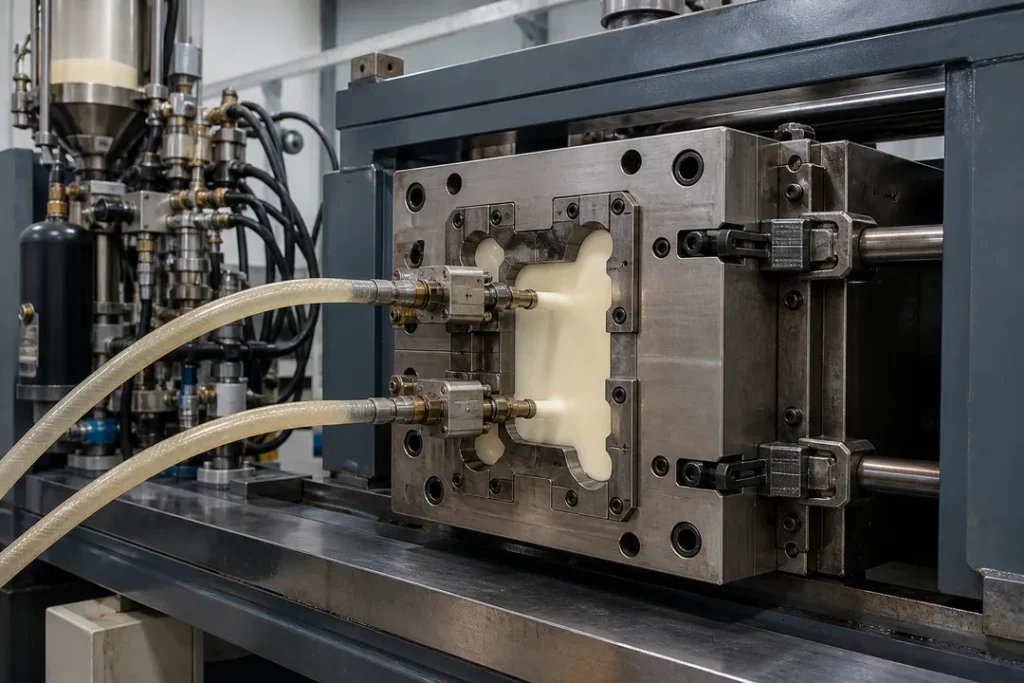
Mold design is the foundation of moulded foam quality. A mold does more than create shape. It controls filling, heating, venting, compression, cooling, demolding, surface texture and dimensional repeatability.
For EPS and EPP bead foam, mold design must include filling guns, steam channels, vents, cooling paths, drainage and ejection systems.
If venting is poor, air can remain trapped and prevent bead fusion. If steam distribution is uneven, some areas may be weak while others are overheated. If cooling is not balanced, the part may warp or shrink.
For EVA and PE compression molding, the mold must control cavity depth, compression ratio, surface texture and release behavior.
The mold should not over-crush the foam cells. It should also allow the part to release without tearing or distortion.
Mold material is also important. Aluminum is commonly used for many foam molds because it conducts heat well and is easier to machine than steel.
Steel may be used when long tool life or high mechanical strength is required. Resin or composite tools may be used for prototypes or low-volume production.
Good mold design also considers maintenance. Vents must be cleanable. Ejection systems must be accessible. Cooling channels should be reliable.
Wear parts should be replaceable. A mold that is difficult to maintain may produce good samples but unstable mass production.
Key Applications of Moulded Foam
Moulded foam is used wherever shape and foam performance must work together. One of the largest application areas is protective packaging.
Moulded foam packaging can hold products securely, absorb shocks and reduce movement during shipping.
EPS is common for cost-effective packaging, while EPP is preferred for reusable or high-performance transport systems.
Automotive applications are another important market. EPP moulded foam is used in bumper absorbers, headrests, seat structures, tool trays, battery protection systems and interior components.
Automotive foam parts must often meet requirements for impact performance, weight reduction and long-term durability.
Construction and insulation use EPS moulded foam for insulation boards, blocks, architectural shapes, concrete forms and lightweight fillers.
EPS provides thermal performance while remaining easy to cut and handle.
Medical and comfort products often use PU, EVA or PE moulded foam.
These applications require pressure distribution, body support, softness and hygiene. Examples include medical pads, orthopedic supports, seat cushions and rehabilitation equipment.
Sports and safety products use moulded foam for helmets, guards, pads, flotation products and protective equipment. The foam must balance comfort, flexibility, impact absorption and recovery.
Quality Control for Moulded Foam Products
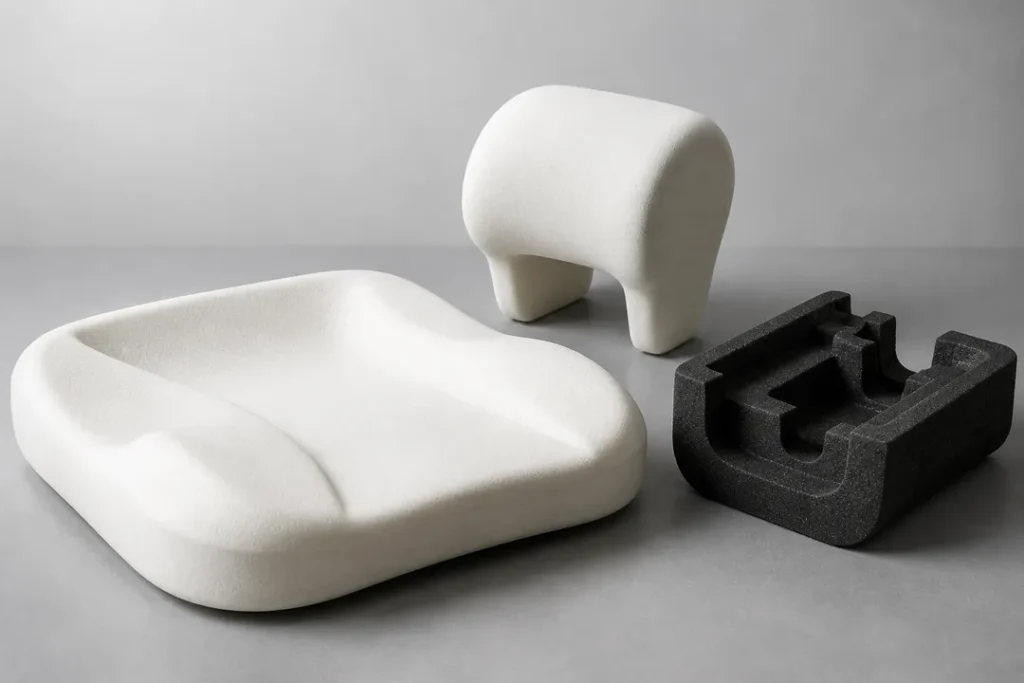
Quality control for moulded foam must evaluate both visible appearance and functional performance.
A foam part may look correct but fail if density, compression behavior or dimensions are outside specification.
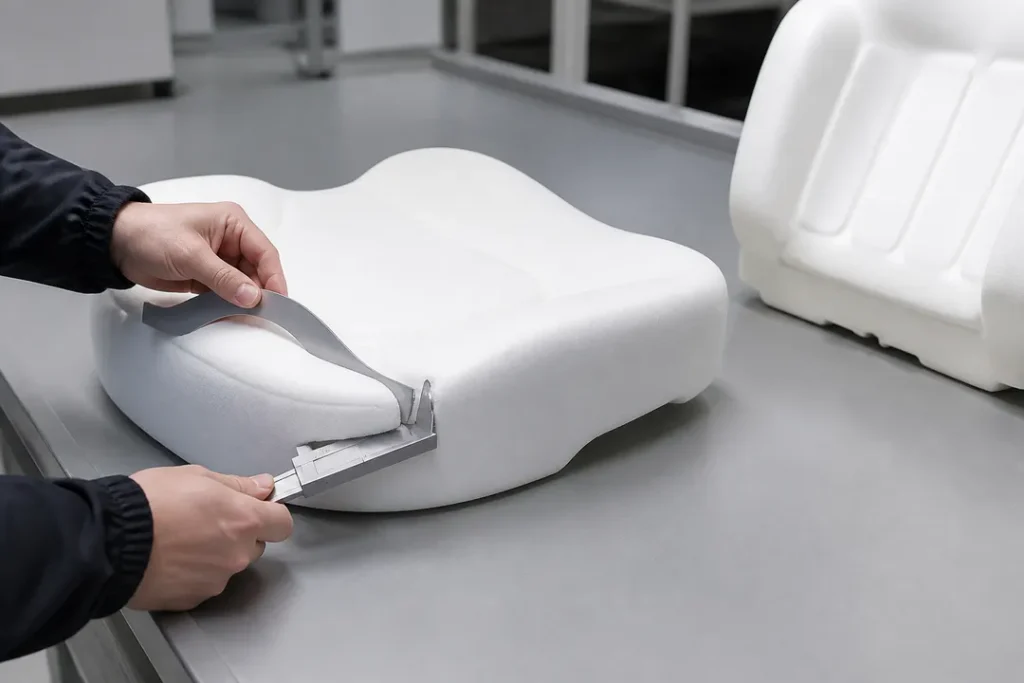
Dimensional inspection checks length, width, height, cavity position, wall thickness, fit and critical geometry.
Foam tolerances are different from metal or hard plastic tolerances, but key dimensions must still be controlled for assembly and function.
Density testing is essential because density affects strength, cushioning, weight, insulation and cost.
In bead foam molding, density variation may indicate problems in pre-expansion, filling or steam fusion.
In sheet foam molding, density confirms material consistency.
Compression testing measures how the foam behaves under load.
Protective packaging, pads and impact parts must compress in a controlled way and recover appropriately. The correct compression behavior depends on product function.
Surface inspection checks for burns, voids, poor fusion, dents, contamination, wrinkles, tears and trimming defects.
For customer-facing products, surface quality affects perceived value. For industrial parts, surface defects may indicate deeper process issues.
A professional moulded foam supplier should define inspection criteria based on actual product use. Not all features are equally important.
Critical support areas, fit surfaces, impact zones and assembly points should receive the most attention.
How to Choose the Right Moulded Foam Material
Choosing the right moulded foam material begins with the application. If the product must be lightweight and low-cost for protective packaging, EPS may be suitable.
If it must survive repeated impact or repeated logistics cycles, EPP may be better. If it must feel soft and comfortable, PU or EVA may be more appropriate.
If it needs chemical resistance and closed-cell performance, PE may be the better option.
Buyers should define mechanical requirements clearly. Does the foam need to support weight, absorb shock, recover after compression, insulate temperature or provide comfort?
Each requirement points toward different materials and densities.
Environmental conditions must also be considered. Temperature exposure, humidity, chemicals, UV light, cleaning methods and repeated handling can all affect foam performance.
A material that works well in indoor packaging may not be suitable for outdoor construction or automotive environments.
Production volume matters as well. For small batches, cutting or simple thermoforming may be more economical.
For high-volume repeated production, investing in a dedicated mold may reduce unit cost and improve consistency.
The best material decision is made by connecting function, process and cost.
Selecting foam only by price often leads to failure. Selecting foam only by maximum performance may create unnecessary cost.
The correct choice balances performance requirements with manufacturing economics.
How to Select a Moulded Foam Supplier
Selecting a moulded foam supplier is not only a purchasing decision. It is an engineering decision.
The supplier must understand materials, molds, process control, finishing and quality inspection.
A supplier who only quotes a price without reviewing the application may not be suitable for custom foam projects.
A strong supplier will ask about product function, dimensions, target density, compression requirements, operating environment, annual volume, packaging method and assembly needs.
These questions help define the correct material and process.
The supplier should also have mold design capability.
For moulded foam, the mold strongly influences quality, cycle time and production cost. Ask how the supplier handles venting, cooling, shrinkage, demolding, surface texture and maintenance.
Sampling and validation are important before mass production. A professional supplier should provide prototypes or samples for fit testing, compression testing and appearance review.
If the product has strict performance requirements, validation should happen before tooling is finalized or mass production begins.
Documentation is another sign of professionalism. Drawings, material specifications, inspection reports, process recommendations and packaging standards help reduce risk.
For international B2B buyers, documentation also improves communication and project approval.
The right supplier should help buyers avoid overdesign and underdesign. Overdesign increases cost unnecessarily. Underdesign creates product failure.
A technically capable supplier helps find the correct balance between performance, mold investment and unit cost.
Conclusion
Moulded foam is foam that has been shaped through a mold or controlled forming process to achieve a specific geometry and function.
It is used when flat foam or simple cutting cannot provide enough fit, performance or repeatability. Depending on the material and process, moulded foam can be soft, rigid, flexible, resilient, insulating, protective or structural.
The most common materials include EPS, EPP, EVA, PE and PU. EPS is often chosen for lightweight packaging and insulation. EPP is selected for durable, reusable and impact-resistant applications.
EVA and PE are used for molded pads, protective inserts and flexible components. PU is widely used for comfort, seating and medical support products.
The quality of a moulded foam product depends on more than material choice. Mold design, process control, density management, heating, cooling, demolding and inspection all influence final performance.
A well-designed foam part should not only look correct. It should protect, cushion, insulate, support or fit exactly as required in real use.
If you are developing a custom moulded foam product, the best next step is to define the application clearly.
Prepare product drawings, target material, density range, performance requirements, production quantity and working environment.
With this information, an experienced foam molding and mold design partner can recommend the right material, process and tooling strategy for reliable production.