
Styrofoam crown molding has become a practical alternative to traditional wood, plaster and polyurethane decorative trim.
It is lightweight, easy to handle, simple to install and suitable for many residential, commercial and architectural decoration projects.
For homeowners, contractors and interior designers, it can reduce installation difficulty and labor cost.
For distributors, project developers and construction-material buyers, it creates a product category that is easier to store, ship and customize than many conventional molding materials.
The question “where to buy Styrofoam crown molding” has more than one answer.
If you only need a small quantity for home renovation, you may buy standard profiles from local building-material stores or online retailers.
If you are a contractor handling repeated projects, you may need a reliable supplier with consistent profile dimensions, coating quality and delivery capacity.
If you are a distributor or brand owner, you may need a manufacturer that can produce custom EPS profiles, develop new molds, support private labeling and provide stable bulk supply.
What Is Styrofoam Crown Molding?
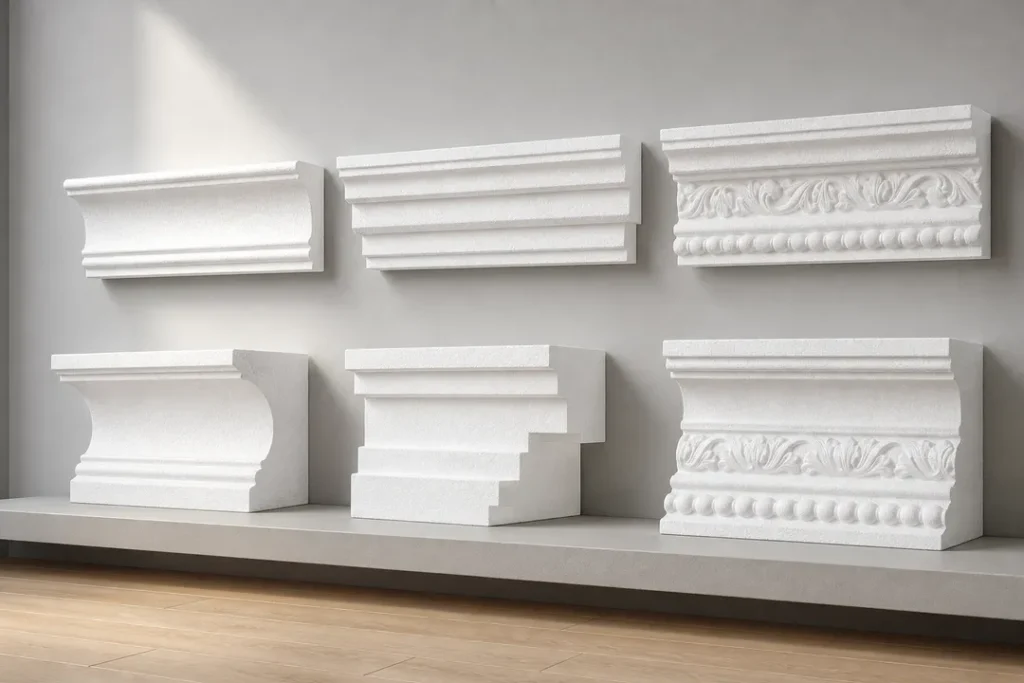
Styrofoam crown molding usually refers to lightweight foam trim installed where the wall meets the ceiling. Its purpose is both decorative and functional.
It can soften the transition between vertical and horizontal surfaces, hide minor gaps, create a finished ceiling edge and add architectural detail to an interior space.
In the marketplace, this type of product may be described as foam crown molding, EPS crown molding, polystyrene crown molding, decorative foam molding, lightweight ceiling trim or architectural foam profile.
Although these names are sometimes used interchangeably, buyers should pay attention to material and finish because not all foam moldings perform the same way.
EPS crown molding is typically made from expanded polystyrene foam blocks or molded foam blanks.
The profile can be created by hot-wire cutting, CNC cutting, molding, lamination or coating.
After shaping, the foam may be coated with cementitious layers, polymer coatings, acrylic coatings, plaster-like finishes or paintable primers depending on the application.
The biggest advantage of foam crown molding is weight reduction. Traditional plaster molding can be heavy and labor-intensive.
Wood molding can be affected by moisture, warping and installation complexity. EPS foam molding is much lighter, which makes handling, cutting and installation easier.
For large decorative profiles, the weight difference can be significant.
For buyers, however, lightweight does not mean low quality.
The final performance depends on foam density, coating strength, dimensional accuracy, surface finish, installation method and supplier consistency.
A well-made EPS crown molding can deliver a clean architectural appearance while reducing installation burden.
Why Buyers Choose EPS Foam Crown Molding
EPS foam crown molding is popular because it solves several practical problems in decoration and construction.
The first reason is ease of installation. Because the material is lightweight, installers can lift, position and fix the molding with less effort.
This is especially helpful for ceiling work, high walls and large-profile decorative trim.
The second reason is cost efficiency. Foam crown molding can reduce labor time and transportation cost.
Large profiles made from plaster or wood may require more workers, stronger fixing systems and careful handling. EPS profiles are easier to cut and modify on site, which can reduce installation difficulty.
The third reason is design flexibility. EPS can be cut into many profile shapes, from simple clean lines to deep decorative cornices.
Manufacturers can produce standard profiles for common interiors or custom profiles for hotels, villas, theaters, restaurants and commercial projects.
The fourth reason is logistics efficiency. Foam molding is lighter than many traditional trim materials, making it easier to pack and ship.
For distributors and international buyers, this can improve container utilization and reduce damage risk if packaging is designed correctly.
The fifth reason is compatibility with finishing systems. EPS crown molding can be primed, painted or coated to match different interior styles.
When properly finished, it can imitate the visual effect of plaster or wood while maintaining lightweight handling advantages.
Where to Buy Styrofoam Crown Molding
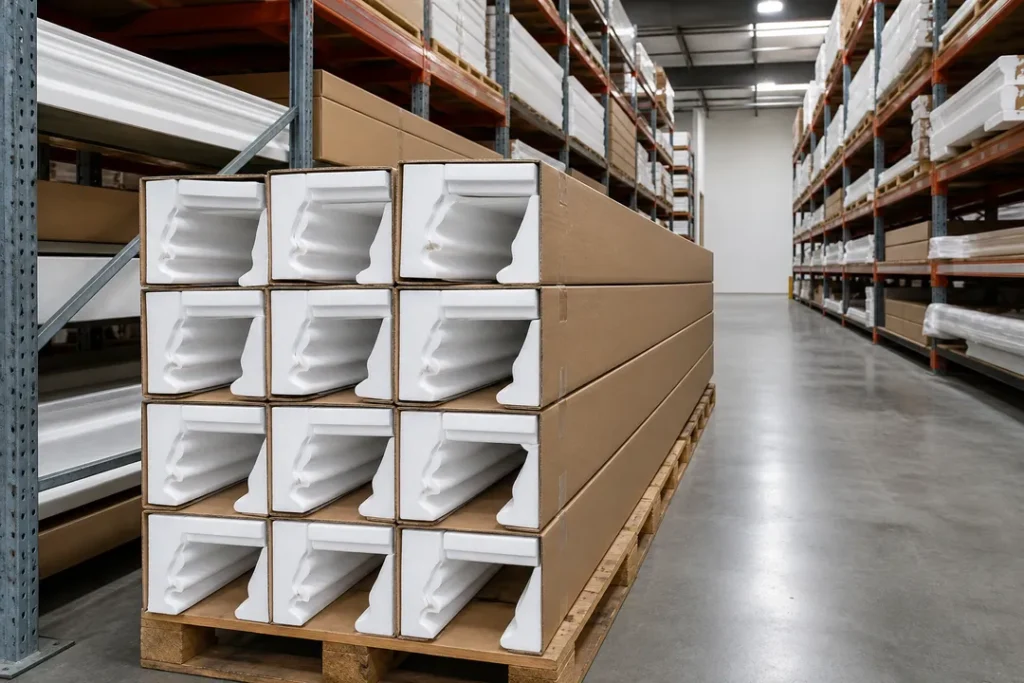
The best place to buy Styrofoam crown molding depends on your purchasing purpose.
A homeowner needs convenience and small quantity.
A contractor needs reliable supply and installation support.
A distributor needs stable quality, competitive pricing and repeatable inventory.
A project developer may need custom profiles and bulk delivery.
A manufacturer may need molds, EPS production capacity or OEM cooperation.
For small renovation projects, local home-improvement stores and online retail platforms are usually the easiest starting points.
These channels provide standard sizes and common profiles. They are useful when you need a limited quantity and do not require custom design.
For professional installers and contractors, decorative molding suppliers are often a better option.
These suppliers may offer broader profile selections, installation accessories, adhesives, coatings and project advice. They may also provide consistent supply for repeated jobs.
For distributors, wholesalers and project buyers, buying directly from foam molding manufacturers can be more cost-effective.
Direct manufacturers can support custom profiles, private labeling, bulk packaging and long-term supply agreements. They can also help optimize product density, coating, length, packaging and container loading.
For buyers who want a unique profile or brand-specific product line, a custom EPS molding or cutting partner is the best choice.
This type of supplier can develop new shapes from drawings, samples or design concepts. They can also provide engineering input to improve manufacturability and reduce cost.
Local Building-Material Stores vs Online Retailers
Local building-material stores are convenient because buyers can inspect products before purchase. You can check profile size, surface texture, rigidity and packaging directly.
If you need the material quickly, local supply can reduce waiting time. This is useful for small repairs, sample testing or urgent renovation work.
However, local stores may have limited profile options. They usually stock standard designs that fit common residential projects.
If you need a special size, large profile, custom density or coated architectural-grade EPS molding, local stores may not be enough.
Online retailers provide more variety and easier price comparison. Buyers can compare profiles, lengths, shipping options and customer reviews.
This is useful for small to medium purchases. However, online buying also has limitations.
Product photos may not fully show surface quality, density or coating strength. Shipping damage can occur if the packaging is weak.
For one-time consumer purchases, online and local channels are practical. For commercial buying, they are usually not enough.
Contractors and distributors need stronger control over consistency, supply continuity, packaging and technical support.
Buying from Contractors and Decorative Trim Suppliers
Decorative trim suppliers often serve contractors, installers and project buyers. Compared with general retailers, they may understand installation details better.
They can advise on adhesive selection, joint treatment, surface preparation and painting compatibility.
This channel is useful when installation quality matters. Crown molding is not only a product; it is part of the finished interior.
Poor joints, weak adhesion, uneven paint or damaged corners can reduce the final appearance. A supplier with installation experience can help avoid these issues.
Some decorative trim suppliers also offer pre-coated or ready-to-paint products. This can reduce on-site finishing work and improve consistency. For commercial projects, this may save labor and shorten installation time.
However, buyers should still evaluate product origin and manufacturing capability. Some suppliers are resellers rather than manufacturers.
This is not necessarily a problem, but if you need custom profiles, bulk export supply or long-term OEM cooperation, you may need to work closer to the production source.
Buying Directly from EPS Foam Manufacturers
For bulk buyers, buying directly from an EPS foam manufacturer can provide stronger control over cost, design and consistency.
Manufacturers can produce foam blocks, cut profiles, apply coatings, develop packaging and adjust specifications according to market needs.
Direct manufacturing is especially valuable when the buyer wants custom crown molding profiles. A manufacturer can work from drawings, CAD files, physical samples or design sketches.
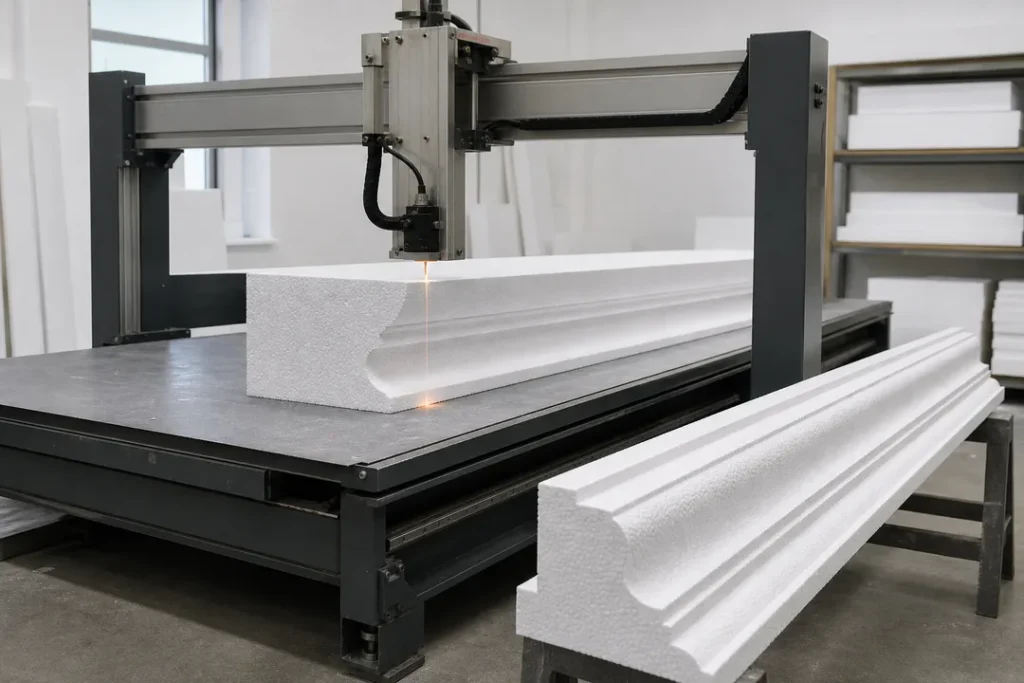
The profile can be cut by hot wire, CNC equipment or custom tooling depending on complexity and quantity.
Manufacturers can also help choose foam density. Lower-density EPS may be cheaper and lighter, but may be less durable.
Higher-density EPS can provide better edge strength and handling resistance, but may cost more. The right density depends on product size, installation environment, coating system and expected durability.
For distributors, direct manufacturing also supports packaging customization.
Products can be packed by profile type, length, project set or retail pack. Labels, barcodes, installation instructions and protective packaging can be designed for the target market.
The main requirement is communication clarity. Buyers should provide profile drawings, size tolerance, surface finish expectation, coating requirement, packaging standard, order quantity and destination market.
The more precise the information, the easier it is for the manufacturer to quote accurately and produce consistently.
When Custom Foam Crown Molding Is the Better Option
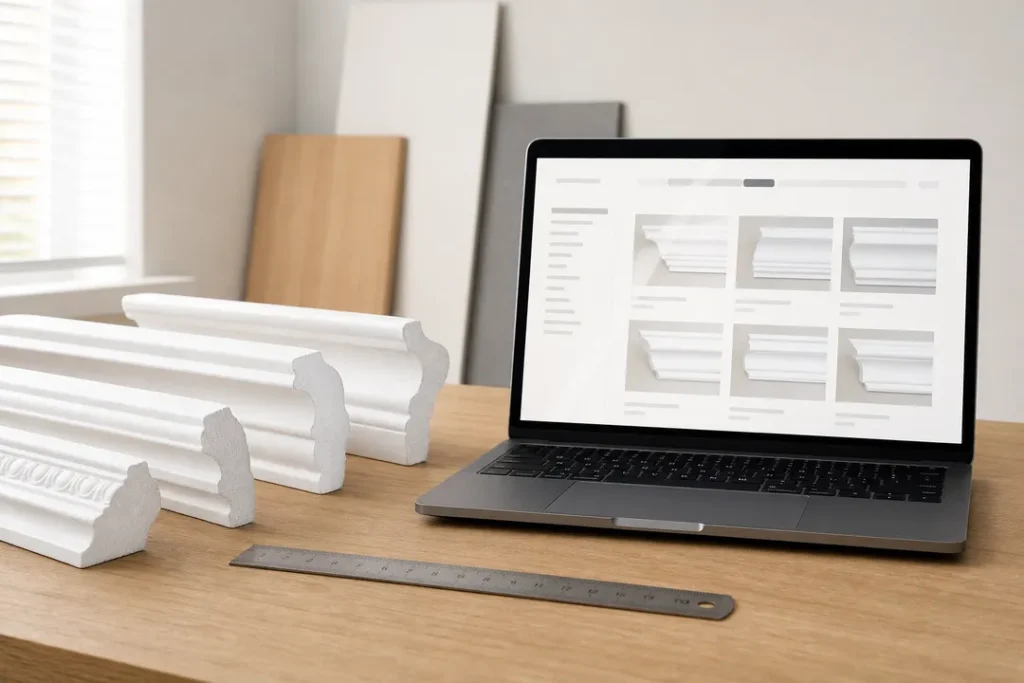
Standard Styrofoam crown molding is suitable for many interior projects, but custom foam molding becomes valuable when standard profiles cannot meet design, scale or branding requirements.
Custom molding is useful for large architectural projects such as hotels, villas, theaters, churches, restaurants, shopping centers and themed interiors.
These projects often require special profiles, oversized cornices, curved sections, matching columns or decorative sets. Standard retail products may not provide the needed visual impact or dimensional fit.
Custom production is also useful for brands and distributors. A unique profile line can help a distributor avoid direct price competition with common retail products.
Private molds, exclusive profiles and branded packaging can create a more defensible product offering.
Custom production may also be necessary when installation conditions are unusual.
High ceilings, curved walls, exterior-like interior environments, large decorative spans or special lighting designs may require modified foam profiles.
In these cases, the supplier should consider not only the profile appearance, but also installation method, joint design, coating strength and transportation protection.
The decision to customize should consider order volume and tooling cost. If the required quantity is small, CNC cutting from EPS blocks may be more economical than developing dedicated molds.
If the product will be produced repeatedly, custom tooling or standardized cutting programs can reduce unit cost over time.
Key Specifications to Check Before Buying
Before buying Styrofoam crown molding, buyers should check several specifications. The first is material type.
Confirm whether the product is EPS, XPS, polyurethane foam or another material. EPS is common for lightweight architectural shapes, but performance depends on density and coating.
The second specification is density. Density affects weight, strength, edge durability and handling performance.
Very low-density foam may be easy to damage during transport or installation. Higher density may improve durability but increase cost.
The third specification is profile dimension. Buyers should confirm width, height, projection, length, profile shape and tolerance.
For large projects, profile consistency is critical because small variations can become visible at joints.
The fourth specification is surface finish. Some foam crown moldings are raw foam and require coating or painting. Others are pre-coated or primed.
Buyers should confirm whether the product is ready to install, ready to paint or requires additional surface treatment.
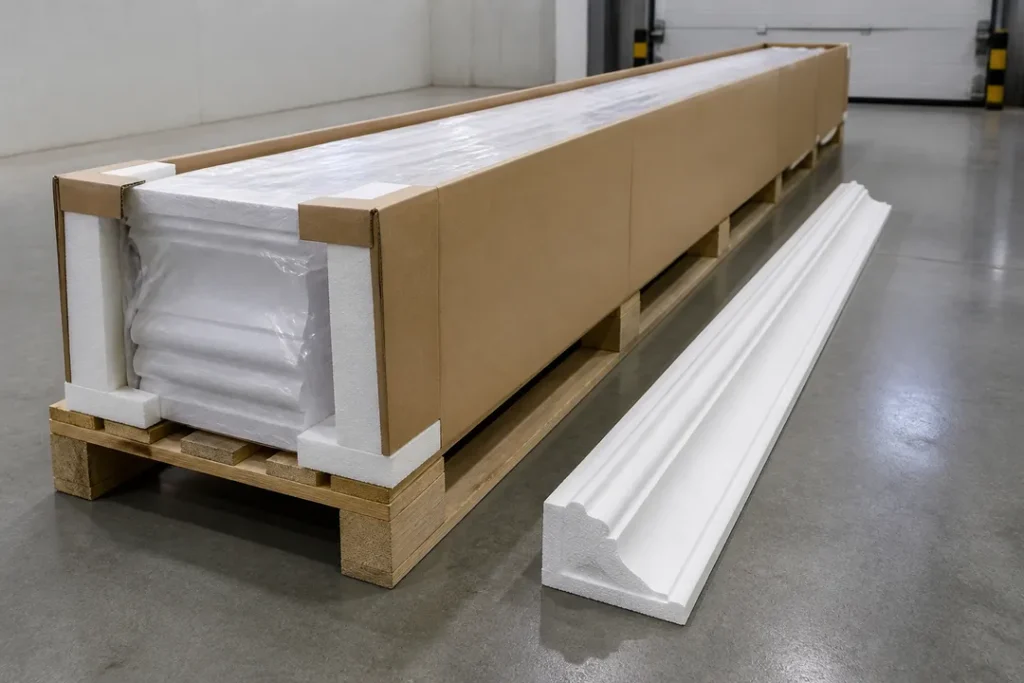
The fifth specification is packaging. Foam trim is lightweight but can be dented or broken if packed poorly.
Long crown molding profiles require protective packaging, corner protection and reasonable bundle design. For export orders, packaging becomes even more important.
Coating, Surface Finish and Fire-Rating Considerations
Coating is one of the most important differences between basic foam trim and higher-quality architectural foam molding.
Raw EPS is lightweight and easy to shape, but its surface is soft. A coating improves durability, paintability, surface smoothness and handling resistance.
Interior crown molding may use lightweight coatings or primers suitable for painting. Commercial or high-traffic spaces may need stronger coating systems.
Some architectural foam products use polymer-modified coatings or cementitious coatings to improve surface hardness and impact resistance.
Fire rating is another consideration. Requirements vary by country, region and building type. Buyers should not assume that all foam crown molding has the same fire performance.
For commercial projects, hotels, public spaces or code-regulated buildings, fire-rating documentation may be necessary.
Paint compatibility also matters. Some paints or solvents can attack foam if the surface is not properly coated. Buyers should use foam-compatible adhesives, primers and paints.
When buying in bulk, it is better to test the complete finishing system before mass installation.
For suppliers, coating capability can be a competitive advantage.
A manufacturer that controls both foam shaping and surface coating can deliver more consistent results than one that only cuts raw foam profiles.
How to Evaluate a Styrofoam Crown Molding Supplier
A good supplier should provide more than product photos and a price list.
Buyers should evaluate whether the supplier understands material, profile design, coating, packaging, installation and quality control.
The first evaluation point is product range. A supplier with multiple profiles, sizes and finish options can serve more project types.
However, a large catalog alone is not enough. The supplier should also maintain consistent dimensions and surface quality across batches.
The second evaluation point is customization capability. If you need special profiles, ask whether the supplier can work from drawings or samples.
Ask whether they use CNC cutting, hot-wire cutting, mold forming or coating lines. Understanding their production method helps you judge whether they can support your project.
The third evaluation point is sample quality. Before bulk purchase, request samples. Check weight, density, edge quality, coating adhesion, surface smoothness and packaging.
A sample cannot guarantee every batch, but it reveals the supplier’s baseline capability.
The fourth evaluation point is communication. A professional supplier should ask about your application, quantity, installation environment, required finish and packaging needs.
If a supplier only pushes standard products without understanding the project, they may not be suitable for B2B or custom orders.
The fifth evaluation point is documentation. For larger projects, ask for product specifications, material information, coating details, packing method and available compliance documents.
Documentation reduces risk and helps with project approval.
Bulk Purchasing for Distributors and Project Buyers
Bulk purchasing of Styrofoam crown molding is different from buying a few pieces for home renovation.
Distributors and project buyers must think about landed cost, container loading, packaging strength, damage rate, inventory turnover and repeat supply.
Because foam molding is lightweight but bulky, shipping efficiency is important.
The supplier should design packaging that protects the product while using space efficiently. Long decorative profiles can waste shipping volume if packaged poorly.
For distributors, SKU planning is also important. Too many profiles can increase inventory complexity.
Too few profiles may limit market coverage. A good manufacturer can help identify which profiles are suitable for standard stock and which should be custom-order items.
Project buyers should confirm delivery schedule and batch consistency.
If a hotel or commercial project uses one profile across many rooms, color, coating and size consistency must be maintained throughout the order.
Mixed batches without control may create visible differences after installation.
For international buyers, communication about Incoterms, packing list, loading method, product labeling and documentation should happen before production.
Export packaging is not a final detail; it is part of product protection.
The Role of Foam Molding and Cutting Technology
The quality of Styrofoam crown molding depends heavily on manufacturing technology. EPS profiles can be produced by hot-wire cutting, CNC cutting, molding or combined fabrication.
Hot-wire cutting is widely used for EPS because it can create smooth profile shapes efficiently. It is suitable for long linear profiles and repeated decorative forms.
The accuracy depends on machine control, wire temperature, cutting speed and foam block quality.
CNC cutting allows more complex geometry and flexible customization.
It is useful for prototypes, custom profiles, special curves and project-specific shapes. CNC can reduce tooling cost for small batches, but cycle time and cost must be evaluated for large production.
Molding may be used when profiles require repeated mass production or specific geometry. Molded EPS parts can offer consistency, but mold investment must be justified by order volume.
For crown molding, cutting from EPS blocks is often more flexible, while molding may be used for special decorative components.
Coating technology is equally important. Even a precisely cut profile can fail commercially if the surface is weak, rough or inconsistent. The best suppliers control both profile forming and surface finishing.
Common Buying Mistakes to Avoid

One common mistake is buying only by price. Low-cost foam crown molding may look attractive, but if density is too low, coating is weak or packaging is poor, damage and installation problems can increase total cost.
Another mistake is ignoring installation compatibility.
Buyers should confirm whether the product works with available adhesives, primers and paints. Using the wrong adhesive or solvent-based coating can damage foam.
A third mistake is failing to request samples. For decorative products, photos are not enough. Buyers should inspect physical samples to judge density, edge quality, surface finish and durability.
A fourth mistake is underestimating shipping protection. Foam is lightweight, but long decorative profiles can break, bend or dent during transport. Proper packaging is essential, especially for export orders.
A final mistake is choosing a supplier without considering repeat supply.
For distributors and contractors, the ability to reorder the same profile with the same quality is critical. A one-time cheap purchase is less valuable than a stable supply relationship.
Conclusion
The best place to buy Styrofoam crown molding depends on your quantity, project type and customization needs.
Small renovation buyers can start with local building-material stores or online retailers. Contractors may benefit from decorative trim suppliers with installation knowledge.
Distributors, wholesalers and project buyers should consider working directly with EPS foam manufacturers for better control over profile design, coating, packaging and long-term supply.
Before buying, confirm the material, density, profile size, surface finish, coating strength, fire-rating requirements, packaging method and supplier capability.
Styrofoam crown molding may seem like a simple decorative product, but for commercial supply and project use, quality consistency matters.
The right supplier can help reduce installation problems, shipping damage and repeat-order uncertainty.
If you need standard profiles, choose a supplier with stable inventory and clear product specifications.
If you need custom foam crown molding, work with a manufacturer that understands EPS cutting, foam molding, coating and packaging.
For distributors and project buyers, direct manufacturing cooperation can turn a simple decorative trim into a scalable product line.
For buyers planning bulk orders or custom EPS decorative profiles, the most effective next step is to prepare profile drawings, required length, density preference, surface finish, order quantity and target market.
With these details, a professional foam manufacturer can recommend the right production method, coating solution and packaging plan for your project.