
Discover what type of foam is used in automotive seats, including molded polyurethane, high-resilience foam, memory foam, EPP, and hybrid seat cushioning solutions.
Automotive seats must provide comfort, support, durability, vibration control, and crash performance at the same time.
Unlike household furniture, a vehicle seat is exposed to constant movement, temperature changes, repeated loading, road vibration, and strict automotive safety requirements.
The foam inside the seat therefore has a major influence on the driving experience and the long-term performance of the complete seating system.
The most common foam used in automotive seats is molded flexible polyurethane foam, especially high-resilience polyurethane foam.
It is used for seat cushions, backrests, headrests, side bolsters, armrests, and other comfort-related components.
Depending on the vehicle design, manufacturers may also use memory foam, latex-like foam, microcellular polyurethane, EPP foam, recycled foam, or multi-density hybrid structures.
The Most Common Foam in Automotive Seats
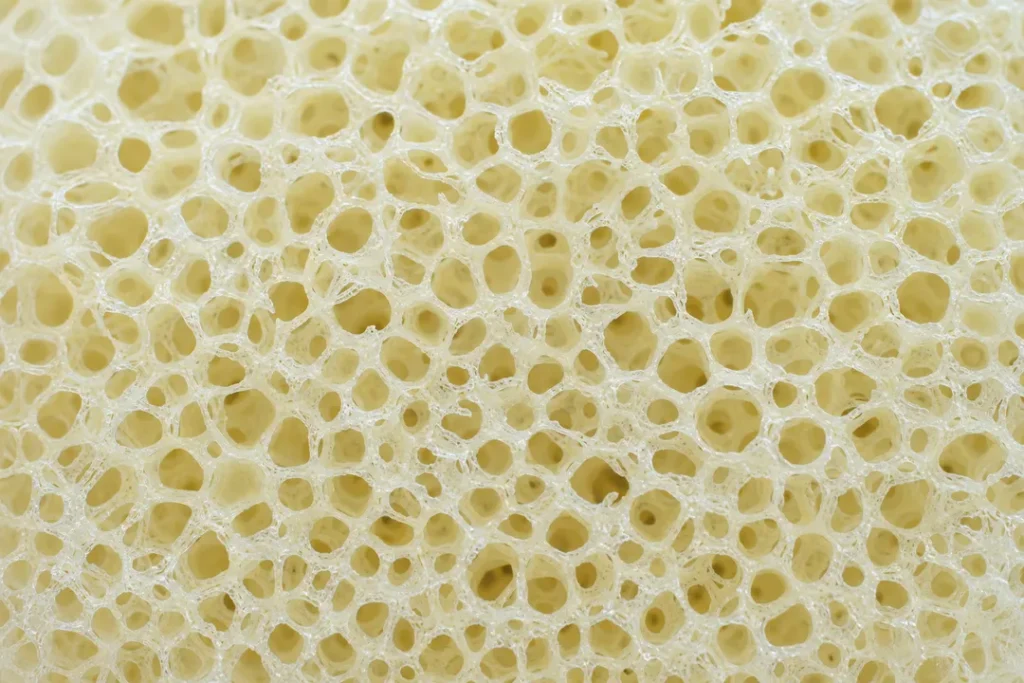
The most widely used material in automotive seating is molded flexible polyurethane foam, commonly called molded PU foam.
It is produced by reacting chemical components inside a seat mold, allowing the foam to expand and form directly into the required cushion or backrest shape.
Molded PU foam is popular because it offers a useful combination of comfort, resilience, support, processability, and design flexibility.
Manufacturers can adjust its density, hardness, airflow, rebound, compression behavior, and local support zones according to the vehicle model.
A single seat may use different foam formulations for different areas. The center of the cushion may be softer for comfort, while the side bolsters may be firmer for lateral support.
The backrest may require a different compression response from the seat cushion, and the headrest may need a controlled balance between softness and impact management.
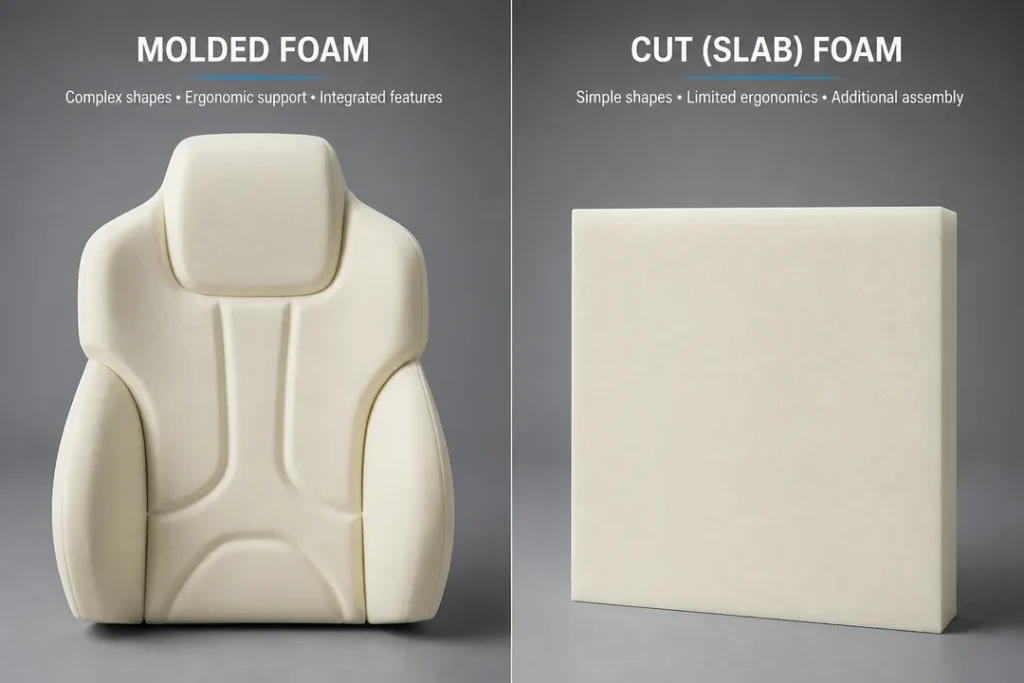
This makes molded PU foam more versatile than a single sheet of standard foam cut into shape.
What Is Molded Polyurethane Foam?
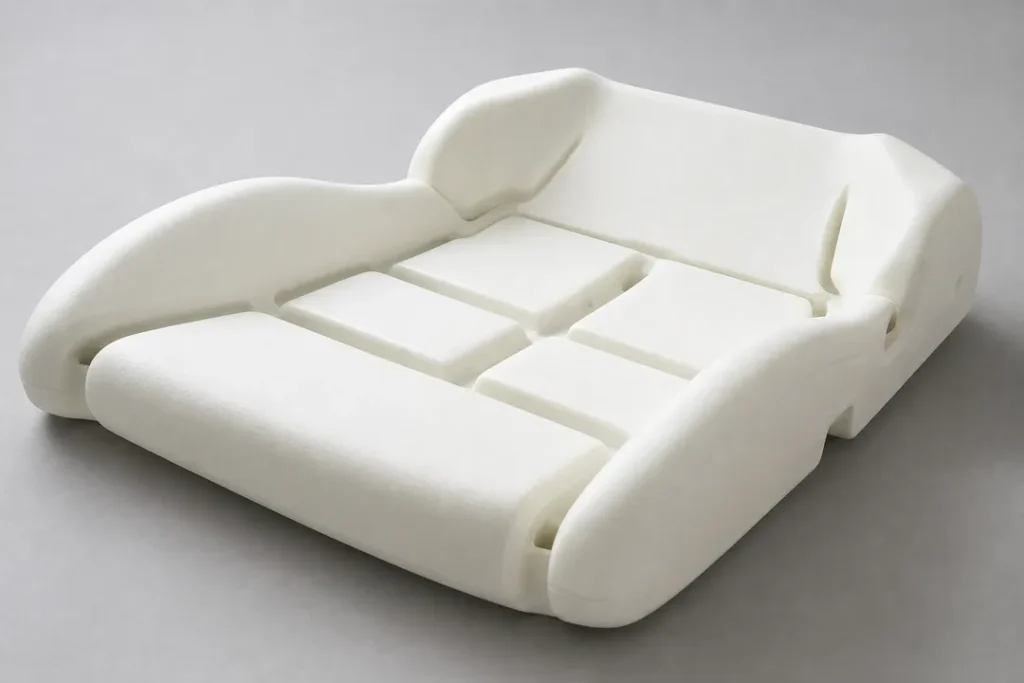
Molded polyurethane foam is a cellular polymer material formed directly inside a dedicated mold.
The liquid raw materials are mixed and poured or injected into the mold, where they react, expand, and cure.
Once the process is complete, the finished foam part is removed from the mold and combined with fabric, leather, trim, support wires, heating elements, ventilation components, or the seat frame.
The mold gives the foam its final three-dimensional form.
This allows manufacturers to integrate contours, channels, attachment points, pressure-relief zones, and different firmness areas into one component.
Molded PU foam also supports efficient mass production. A properly designed automotive seat mold can produce consistent parts with repeatable dimensions and stable quality.
For OEM and tier suppliers, this repeatability is important because seat components must fit the vehicle interior and work correctly with restraint systems, trim, sensors, and adjustment mechanisms.
Why High-Resilience Foam Is Used in Car Seats
High-resilience foam, often called HR foam, is a flexible polyurethane foam designed to recover quickly after compression.
This property is important because automotive seats experience thousands of loading cycles throughout their service life.
When a driver or passenger sits down, the foam compresses and distributes body weight across the seat.
When the person moves or leaves the seat, the foam needs to recover without developing excessive permanent deformation. Good recovery helps maintain comfort, seat height, body support, and visual appearance.
HR foam can also be produced with different hardness zones. A softer area may improve pressure relief, while a firmer area can support the pelvis, thighs, shoulders, or side body.
This allows vehicle manufacturers to tune the seat for long-distance comfort, sporty handling, commercial-vehicle durability, or premium interior feel.
Another benefit is vibration damping. The foam can help reduce the transmission of road vibration into the passenger’s body, especially when combined with springs, suspension systems, seat structures, and other NVH components.
Is Memory Foam Used in Automotive Seats?
Memory foam can be used in automotive seats, but it is usually applied selectively rather than used as the only structural cushioning material.
Memory foam responds slowly to pressure and temperature, allowing it to conform closely to the occupant’s body. This can improve pressure distribution and perceived comfort.
However, memory foam may not provide the same quick recovery and long-term support required in every seat area.
It can also behave differently under cold and hot conditions. For this reason, automotive manufacturers may use memory foam as a comfort layer over a stronger HR polyurethane base.
This layered structure combines the support and durability of HR foam with the pressure-relief characteristics of memory foam.
It may be found in premium seats, luxury vehicles, ergonomic seat packages, or aftermarket comfort products.
The selection depends on climate, seat architecture, target customers, cost, durability testing, and the required seating feel.
Where EPP Foam Fits in Automotive Seating
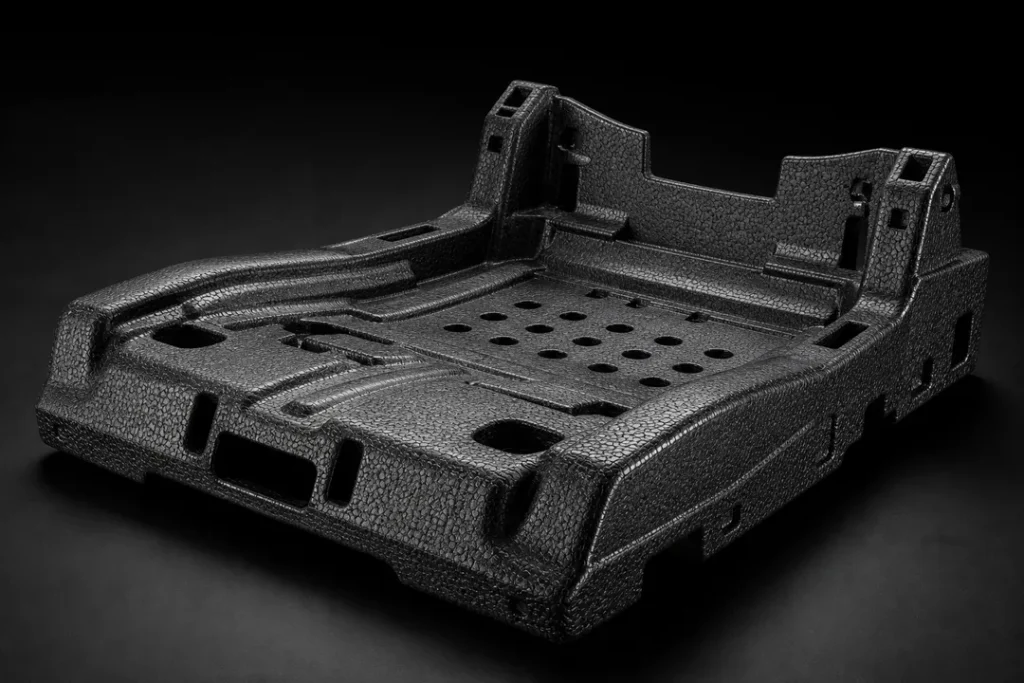
EPP, or Expanded Polypropylene foam, is different from soft PU seating foam.
It is a lightweight, resilient, closed-cell material that is often used where impact absorption, structural support, vibration damping, or low weight is important.
EPP may be used in seat cores, headrest structures, side-impact protection, knee bolsters, seat-back panels, child-seat components, and other semi-structural seating applications.
It can also be molded into complex shapes and integrated with plastic or metal parts.
Compared with conventional soft polyurethane foam, EPP is generally more resilient and better suited to repeated impact and compression. It can also provide useful moisture resistance and dimensional stability.
In many vehicles, EPP and PU are complementary rather than competing materials.
PU may deliver the primary softness and comfort, while EPP provides lightweight structural cushioning or impact management in selected zones.
Seat Cushion Foam and Backrest Foam
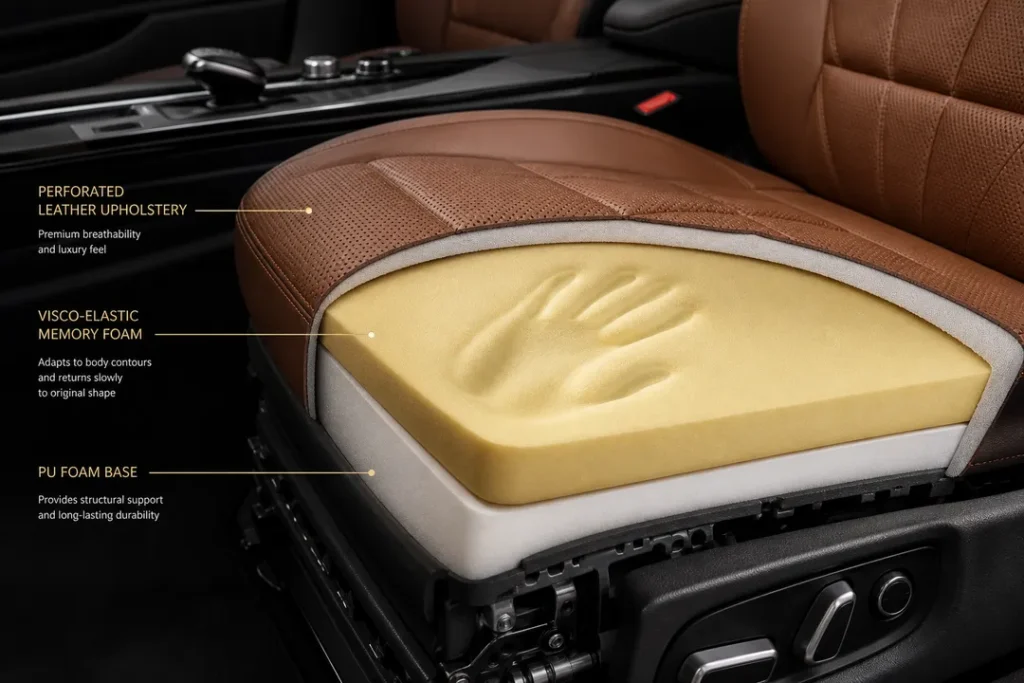
Seat cushions usually require a carefully balanced combination of softness, support, rebound, fatigue resistance, and pressure distribution.
If the cushion is too soft, the passenger may feel unstable or sink too deeply. If it is too hard, pressure can build up under the thighs and pelvis during long journeys.
For this reason, seat cushion foam is often designed with a specific density and hardness profile.
The foam must support the occupant while working with the seat springs, frame, cover, heating system, ventilation system, and adjustment mechanism.
Backrest foam has a different role. It must support the back and shoulders while allowing comfortable movement.
It may use a softer surface zone, firmer lumbar support, or integrated channels for wiring and ventilation. In commercial vehicles, backrest foam may be formulated for high durability and frequent entry and exit.
Both cushion and backrest foam must maintain their properties under temperature changes, humidity, repeated compression, cleaning, and daily use.
Foam Used in Headrests and Side Bolsters
Headrest foam must provide comfort while supporting the head and neck. It is often molded around a metal or plastic support structure.
The foam formulation and geometry influence the softness, shape retention, and response during rear-impact conditions.
Side bolsters are designed to help keep the occupant in position during cornering and vehicle movement.
They may use firmer foam than the center of the seat. In performance vehicles, bolsters are usually more pronounced and require stronger shape retention.
In family vehicles, the design may prioritize easier entry and exit.
EPP, microcellular polyurethane, and specially formulated flexible PU materials can all be considered for headrest and bolster-related components.
The correct choice depends on the seat structure, safety target, comfort expectation, and manufacturing process.
Foam Requirements for Electric Vehicle Seats
Electric vehicles introduce several new requirements for seat foam.
EV seats may include batteries, sensors, heating and ventilation systems, electronic controls, lightweight frames, and new interior layouts.
These systems create additional packaging and thermal-management challenges.
Low-density foam can help reduce seat weight, which supports vehicle efficiency. At the same time, the foam must maintain sufficient support and durability.
EPP may be attractive in selected structural or impact-management zones because of its low weight and resilience, while molded PU remains common for the main comfort cushion.
EV seat foam may also need to support:
- Lightweight seat structures
- Battery and electronic component clearance
- Vibration and noise reduction
- Thermal comfort and ventilation
- Compatibility with seat sensors
- Low emissions and low odor
- Fire-performance and regulatory requirements
- Long-term resistance to compression set
The best material is determined through complete seat-system testing rather than by foam type alone.
Automotive Seat Foam Comparison
| Foam Type | Main Advantages | Typical Automotive Use |
|---|---|---|
| Molded PU Foam | Comfortable, customizable, cost-effective | Seat cushions and backrests |
| High-Resilience PU Foam | Good recovery, support, and fatigue resistance | Main seating foam |
| Memory Foam | Pressure relief and premium comfort | Comfort layers and luxury seats |
| EPP Foam | Lightweight, resilient, impact-absorbing | Seat cores, bolsters, protection parts |
| Microcellular PU | Compact, durable, vibration damping | Headrest dampers and NVH parts |
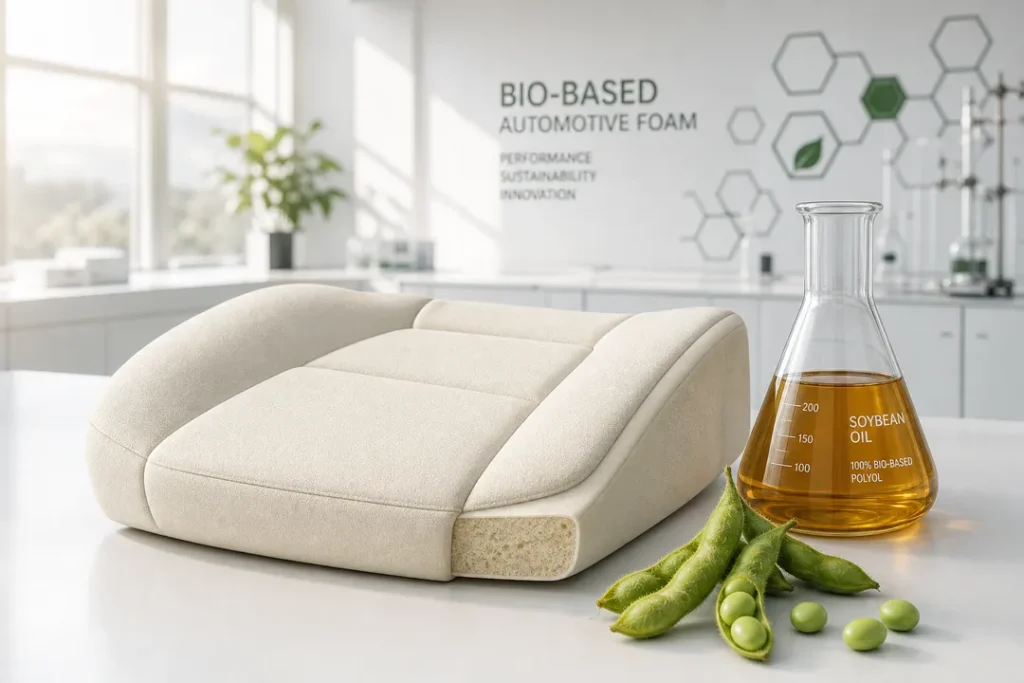
| Recycled or Bio-Based PU Foam | Lower environmental impact potential | Sustainable seating programs |
How Manufacturers Choose the Right Seat Foam
Automotive seat foam should be selected according to the complete seat system and vehicle application. Important evaluation factors include:
- Density and hardness
- Indentation force deflection
- Resilience and compression set
- Fatigue performance
- Temperature resistance
- Air permeability and thermal comfort
- Flammability and emissions
- Noise and vibration behavior
- Compatibility with covers, adhesives, wires, sensors, and frames
- Mold design and production volume
- Recyclability and sustainability targets
A foam supplier should be able to provide material data, sample parts, mold trials, process support, and quality documentation.
For customized seats, the supplier should also understand how foam density and hardness affect ergonomics, occupant positioning, durability, and assembly.
The mold is equally important. A high-quality automotive seat foam mold helps control dimensions, surface quality, density distribution, insert positioning, and repeatability.
Poor mold design can lead to inconsistent filling, voids, deformation, difficult demolding, and unstable seat performance.
Conclusion
The most common foam used in automotive seats is molded high-resilience polyurethane foam.
It provides the comfort, support, durability, and design flexibility required for modern seat cushions and backrests.
However, automotive seating is not limited to one foam type.
Memory foam can improve pressure relief, EPP foam can support lightweight impact-management structures, and microcellular polyurethane can provide vibration damping in compact components.
Many advanced seats use a combination of foam materials, each selected for a specific function.
For automotive manufacturers, the right foam depends on vehicle type, seat architecture, safety targets, climate, durability requirements, production volume, and cost.
A successful seat project requires coordinated work between the foam supplier, mold manufacturer, seat-system engineer, and vehicle OEM.
If you are looking for customized automotive seat foam, EPP seat components, PU molded foam, or automotive seat molds, contact us for material selection, mold development, sample testing, and production support.